
Independent Contractor Agreement template UK
Use our Independent Contractor Agreement template to create your own legal document easily. Agree to terms with a contractor to receive a service and ensure your interests are protected.

Fill forms in a few steps
Save, print & download
Done in 5 minutes
What is an independent contractor?
An independent contractor is a self-employed professional who provides services to clients under a contract for services, rather than as an employee.
Unlike employees, who work directly for a company and receive a salary and employment benefits, independent contractors operate their businesses and take responsibility for their successes and failures.
In the United Kingdom, determining whether someone is an independent contractor involves understanding their:
- Tax status
- Control over work
- Type of agreements
Independent contractors are responsible for their own tax affairs, including the payment of Income Tax and National Insurance through the Self-Assessment tax return system.
Using our Self-Employed Contract template for UK services will help you accurately record your fees and make tax filing easier in the future.
Types of contractor services
Independent contractors will offer services in one or more areas. You might offer or find services in one or more of the fields below:
- Personal assistant
- Photographer
- Interior designer
- Repairman
- DJ
- Babysitter
- Electrician
- Plumber
- Gardener
Use our Contractor template to create your document in the field that applies to you and your needs.
Independent Contractor Agreement sample
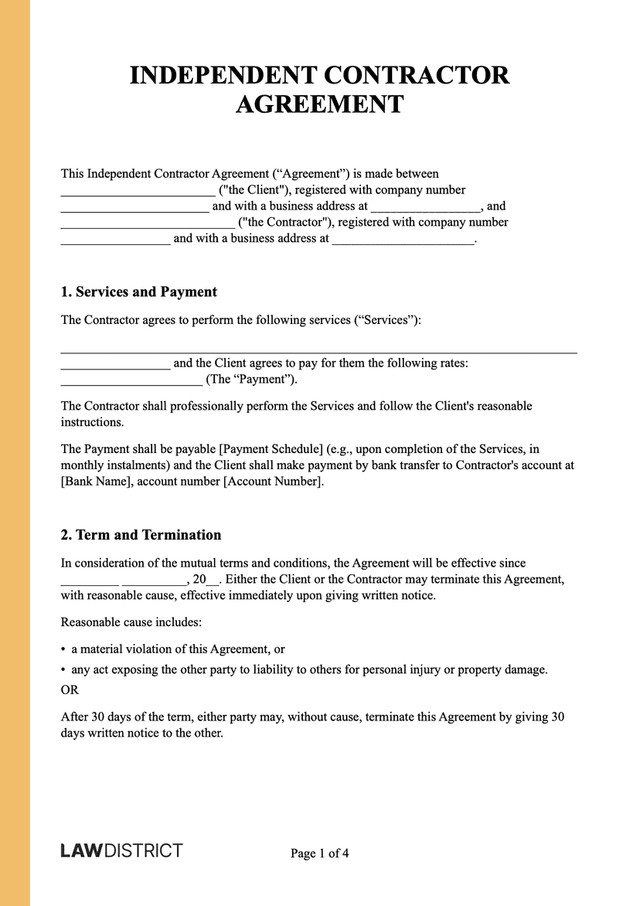
Creating legal forms can be difficult if you do not know where to begin. If you’re not sure how to start drafting your own document or what one should look like, it’s best to look over an example.
Review the Self Employment Contract template below to better understand how your agreement should look when completed.
When to use an Independent Contractor Agreement?
An Independent Contractor Agreement in the UK is essential whenever professional services are completed outside the traditional employer-employee set-up, such as working full-time or part-time for a company or organisation.
If you fall into this category as you are working for yourself or hiring someone for freelance employment, here is when you should use an Independent Contractor Agreement:
- Starting a new project: Before beginning any work, you should come to terms and formalise an agreement.
- Engaging in short-term or project-based work: An agreement clarifies expectations for tasks with a defined timeframe or specific objectives.
- Working with multiple clients: If you juggle various projects simultaneously, agreements with each client keep your engagements organised and protected.
- Plan on modifying terms: Any change in the scope of work, compensation, or project timelines should be documented and agreed upon through a revised contract.
Ultimately, a work agreement with a contractor is pivotal for safeguarding the interests and expectations of both parties in freelance or self-employment engagements, contributing to a smooth and transparent working relationship.
What should be included in an Independent Contractor Agreement?
You must have all the necessary details in your Contractor Agreement to guarantee mutual understanding between you and the other party in your agreement.
Here are key components that should be included:
- Parties' details: Full names and contact information of each party.
- Scope of Work: Detailed description of the services to be provided, including any deliverables or milestones.
- Payment terms: Amount and time of payments and how payment will be provided.
- Duration of agreement: Start and end dates of the contract, including any provisions for extension.
- Terms of termination: Conditions under which either party can terminate the agreement.
- Confidentiality and intellectual property: Clauses to protect sensitive information and outline the ownership of any work produced. You can find a complete Confidentiality Agreement Template in our platform.
- Liability and insurance: Details of any insurance requirements and liability clauses.
- Governing law: The legal jurisdiction that will govern the agreement.
Including these elements in your Independent Contractor Agreement will help safeguard your interests, clarify expectations, and minimise potential disputes.
How to write an Independent Contractor Agreement
Creating an Independent Contractor Agreement in the United Kingdom is straightforward if you follow the steps below.
Complete each step using our user-friendly Contractor Agreement template to create a detailed agreement successfully:
- State the full names, addresses, and contact details of each party involved in the agreement.
- Detail the services to be provided, including any specific tasks, deliverables, and deadlines.
- Specify the payment amount, schedule, and method. Include rates for services, invoicing frequency, and any late payment penalties.
- List the start and end dates of the contract. Include terms for an extension if applicable.
- Define how either party can terminate the agreement, including notice periods and any obligations upon termination.
- Include clauses that safeguard sensitive information and specify the ownership of materials produced.
- Mention any insurance requirements and how liability is handled within the scope of work.
- Indicate the legal jurisdiction and the agreed method for resolving any disputes.
- Ensure both parties sign the agreement. In the UK, while not always necessary, it's advisable to have witnesses to the signing to add an extra layer of authenticity.
You can make the entire writing process easier with our Independent Contractor Agreement template. Our template allows you to customise your document with the information you want to include.
FAQs about Independent Contractor Agreements
There may be some confusion or specific questions you have regarding how to set up your contract. If that’s the case, examine the answers to some of the most common questions below to clear up any doubts.
Both contractors and clients often go to a lawyer to draw up their contracts; however, this usually comes with large fees.
Alternatively, you can use our printable Independent Contractor Agreement UK-specific template.
With our form, you can customise your legal document and include all the terms you wish without paying hefty fees.
There are several things you must do to set yourself up as an independent contractor in the UK. You will have to:
- Identify your service or niche
- Register as self-employed with HM Revenue & Customs (HMRC)
- Consider setting up a separate business bank account to manage your finances
- Network and market your services
Lastly, ensure you have a solid and personalised Independent Contractor Agreement to use with your clients.
In the UK, employees typically work under a contract of employment, have set hours, and are subject to the employer's control, receiving a regular salary and benefits like holiday pay.
Independent Contractors, on the other hand, operate under a contract for services, have more control over how they work, bear their own financial risks, and do not receive employee benefits. They typically provide services to multiple clients, highlighting their business independence.
If you have any doubts about a contractor’s tax status, you can check it with the CEST tool on the UK government website.
As a self-employed person in the United Kingdom, you need to keep accurate business records so you can figure out your profits or losses and show them to HMRC if asked.
Acceptable proof of your self-employment includes bank statements, sales invoices and receipts, expenses records, and copies of your Self-Assessment tax returns.
With a Contractor Agreement, you can also support your status by showing the terms of work you’ve carried out.
Try Lawdistrict Now
Instant and complete access to our entire library of legal forms
Edit, download and print in PDF from any device
Save time and money on legal document creation