
Free Eviction Notice Template UK
Repossess your property with ease by using our customisable Eviction Notice (also known as Eviction Letter) template. Meet all legal requirements wherever you are in the UK and make the eviction process simple. Our Eviction Notice template has been fully updated to comply with the Renters' Rights Act.

Fill forms in a few steps
Save, print & download
Done in 5 minutes
What is an Eviction Notice?
An Eviction Notice, or Notice of Seeking Possession, is a formal declaration from a landlord to a tenant indicating that the tenant must leave the rented property by a specified date.
Up until May 1 2026, landlords were able to rely on a Section 21 notice, also known as a no-fault eviction notice, to evict tenants from their properties without having to give a reason. However, the Renters’ Rights Act, which came into force on May 1 2026, has abolished this mechanism.
As a result, a landlord can no longer evict a tenant at will by giving notice. Under the new legal regime, a landlord can terminate a tenancy only if one of the legal grounds specified in section 8 of the Housing Act is available.
An Eviction Notice it’s designed to provide tenants with a clear timeframe to fix the issue or prepare to vacate the property.
Creating this document is the first step in the legal eviction process and serves as a basis should the matter end up in court.
The reasons for giving a tenant a Notice of Eviction Letter:
- Non-payment of rent
- Breach of rental agreement terms
- Property damage by the tenant
- Unlawful activities conducted on the premises
When to use an Eviction Notice in the UK?
In the UK, there is no single, country-wide law that applies to how a landlord can terminate a tenancy via eviction notice. Instead, there are different laws and regulations related to eviction notices across England, Wales, Scotland, and Northern Ireland.
Despite these country-level differences, landlords usually use an eviction notice under two particular circumstances:
- When the fixed term of the tenancy has ended
- The tenant has breached the tenancy agreement or another valid legal ground applies under Section 8 (If the property is in England)
If you decide to issue an eviction notice to the tenant to terminate the tenancy and repossess your property, you must comply with the eviction notice procedure that applies to the tenancy.
Depending on the country, you will need to use the appropriate Eviction Notice, depending on why you are evicting the tenant.
Pre-made Eviction Notice templates can be used to make the drafting process quicker. Download our Eviction Notice template to avoid creating the wrong type of form when you plan on reclaiming your property.
Eviction Notice sample
If you have never seen an Eviction Notice in the UK, reviewing an example document is a good idea.
Look over the sample below to fully understand how to structure your document and better understand what you need to include.
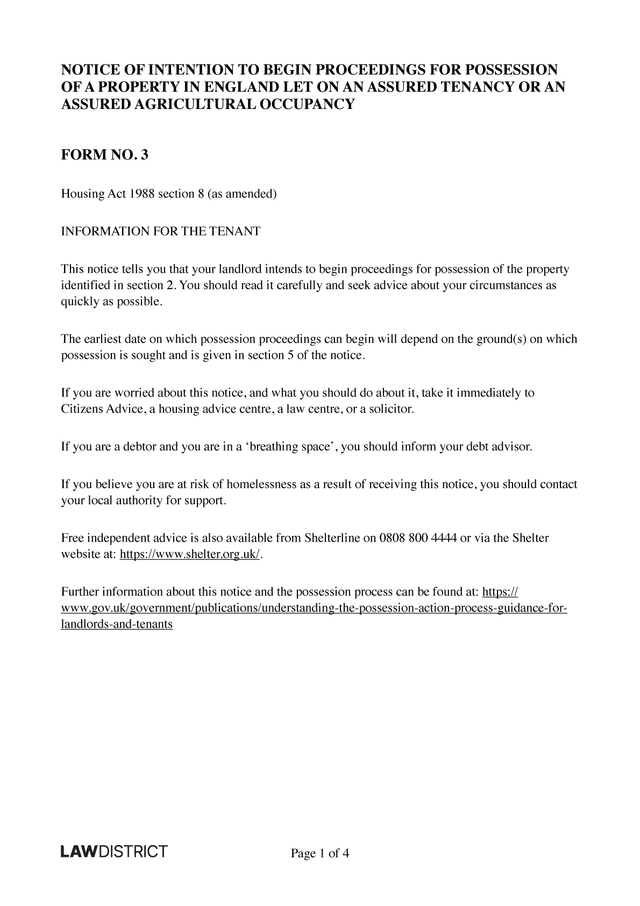
Eviction Notice in England
In England, the Renters’ Rights Act entered into force on 1 May 2026 and introduced substantial changes to private tenancies in England. Notably, landlords can no longer use a Section 21 notice to end a private tenancy without giving a reason.
Under the new law, you must now use a Section 8 notice and rely on one of the specific legal grounds listed in Schedule 2 of the Housing Act 1988.
You can only use a Section 8 notice if one of these grounds is applicable.
Common grounds you may rely on to terminate the tenancy under Schedule 2 include:
- Rent arrears
- Breach of the tenancy agreement
- Other legal reasons set out in Schedule 2 of the Housing Act 1988
- The landlord or their spouse or children need to move into the property
You must use the correct official form (Form 3A), or a form substantially to the same effect, and give the right notice period for the ground you are using.
If you fail to comply with the statutory requirements, such as relying on an incorrect ground or serving an invalid notice, this may render your eviction notice ineffective and may result in the rejection of the possession proceedings by the court.
In certain circumstances, landlords may even face financial penalties for failure to comply with the law. For instance, if a landlord serves an invalid eviction notice to a tenant and the tenant vacates the property, the landlord may face financial penalties under certain conditions.
Section 8 Notice Periods
The notice period depends on the grounds of the eviction:
| Ground | Reason | Notice Period |
|---|---|---|
| Ground 1 | Landlord plans to live in the property | 4 months |
| Ground 1A | Landlord intends to sell | 4 months |
| Ground 2 | Mortgage lender repossession | 2 months |
| Ground 6 | Landlord plans to redevelop | 4 months |
| Ground 7 | Former tenant is deceased | 2 months |
| Ground 7A | Tenant conviction or antisocial behaviour order | 4 weeks |
| Ground 7B | Tenant has no legal right to rent | 2 weeks |
| Ground 8 | Serious rent arrears (3+ months or 13+ weeks) | 4 weeks |
| Ground 10 | Some rent arrears | 4 weeks |
| Ground 11 | Repeated late payment | 4 weeks |
| Ground 12 | Breach of tenancy terms | 4 weeks |
| Ground 14 | Antisocial behaviour | 2 weeks |
| Ground 14ZA | Serious offence during a riot | 2 weeks |
| Ground 17 | False information used to obtain tenancy | 2 weeks |
Eviction Notice in Wales
In Wales, eviction rules are set out in the Renting Homes (Wales) Act 2016. Landlords must follow a different system from England.
The Notice Requiring Possession, or Section 173 Notice, allows landlords to terminate standard contracts without specifying a reason.
This notice requires a 6-month period, starting the day after it's served, and must be issued using specific forms to be legally valid.
If the contract-holder has breached the agreement (for example, rent arrears or anti-social behaviour), you must use a possession notice based on a legal ground under Welsh law.
If the contract-holder does not leave after the notice period, you must apply to the court for a possession order.
Eviction Notice in Scotland
Scotland's Eviction Notice system, under the private residential tenancy rules, provides a structured approach for landlords to end tenancies.
If you want to end a tenancy, you must usually give your tenant a Notice to Leave.
A Notice to Leave must state a valid legal ground for eviction, such as rent arrears or breach of tenancy terms.
If the tenant does not leave when the notice period ends, you must apply to the First-tier Tribunal for Scotland for an eviction order.
Using the Notice that is right for your situation will reduce your problems when reclaiming your property.
Eviction Notice in Northern Ireland
If you are a landlord seeking to end a tenancy in Northern Ireland, your options will be similar to those in Scotland.
You must provide an Eviction Notice/Notice to Quit to your tenant.
The notice period depends on how long the tenant has lived in the property:
- 4 weeks’ notice if the tenancy has lasted up to 10 years
- 8 weeks’ notice if it has lasted more than 10 years
- 12 weeks’ notice if it has lasted more than 20 years
Should your tenants remain in the property beyond the Notice to Quit period without your consent, you must apply to the court for a possession order.
Doing this will demonstrate your intention to pursue eviction through the courts, aiming to secure a possession order.
Applicable Eviction Notice laws
There are a number of important housing laws throughout the UK that you should be familiar with if you plan to begin eviction proceedings.
Here are some laws you should look over depending on your type of property and tenancy agreement:
- Housing Act 1988: Introduces assured tenancies and standard contracts, and clarifies landlords' and tenants' rights and obligations.
- Renters’ Rights Act 2025 (England): Introduced major reforms, including the abolition of Section 21 “no-fault” evictions.
- Renting Homes (Wales) Act 2016 – Governs occupation contracts and eviction procedures in Wales.
- Private Housing (Tenancies) (Scotland) Act 2016 – Covers private residential tenancies and eviction grounds in Scotland.
- Protection from Eviction Act 1977: Protects tenants from eviction without due legal process.
- Notices to Quit (Prescribed Information) Regulations 1988: Mandates the inclusion of specific information in notices to quit, to guarantee tenants are well-informed of eviction proceedings.
Review these laws and any related acts to make sure that you fulfil your obligations when drafting your eviction notice form and when evicting your tenant.
Eviction Notice FAQs
To ensure you have no doubts when creating your Eviction Notice, you can review our answers to the following common queries below.
Delivering an Eviction Notice in the UK must follow all legal requirements. This will depend on he type of tenancy and the part of the UK you’re in. Common methods include:
- Hand delivery,
- Sending it via registered post
- Email if previously agreed upon in the tenancy agreement
It's crucial to obtain proof of delivery, such as a signed receipt or email read receipt, to confirm the tenant has received the notice.
The amount of required notice in the UK varies depending on where the property is, the type of tenancy and the grounds for eviction.
In England,notice periods now depend on the legal ground used. Some grounds (such as serious rent arrears or anti-social behaviour) may require shorter notice, while others (such as selling the property or moving in) usually require longer notice periods.
In Scotland and Northern Ireland, the notice period can vary from 28 days to several months, based on when the tenancy began or the reasons for eviction.
Always check current legislation for the most accurate requirements.
If you are served with a legal notice to quit as a resident of a rented property, the document will notify you of how many days you have to vacate.
This may be as effective immediately in certain cases, or as long as 60 days, depending on the circumstances of the eviction, the laws set in the jurisdiction you’re living in, and the property in question.
Try Lawdistrict Now
Instant and complete access to our entire library of legal forms
Edit, download and print in PDF from any device
Save time and money on legal document creation