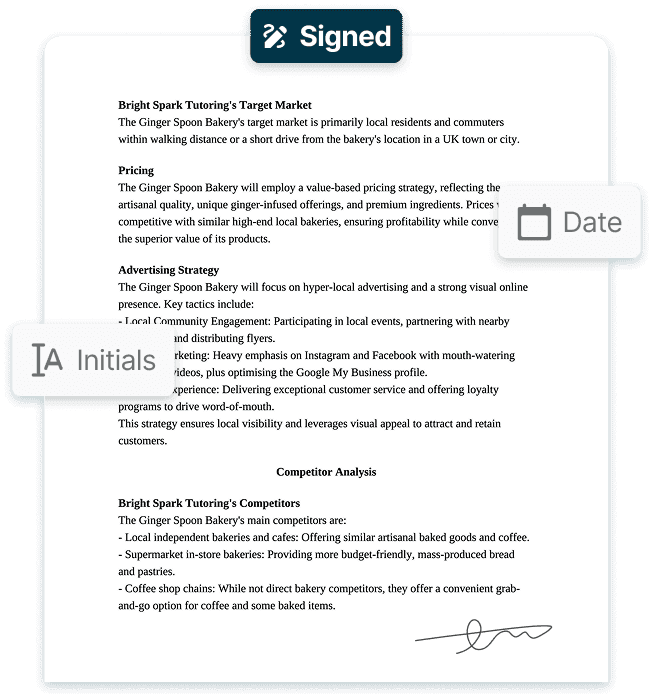

Upload your document
You can upload both PDF and Word documents to Lawdistrict.

Electronic signatures allow you to sign documents digitally without physical paper or ink. Our intuitive online document signing tools are quick and easy to use.
E-sign
Trusted by 5024 users
Upload your file here to start
Max file size: 20MB | PDF and Word documents
By uploading your document you are agreeing to Lawdistrict’s Terms and Conditions and Privacy Policy.
Using our platform, you can easily sign legal documents in three quick steps:
Upload your document
You can upload both PDF and Word documents to Lawdistrict.
Enter your information
Place the fields and sign your document.
Download your signed document
Instantly download your legally binding Word or PDF documents.
Fast and simple electronic document signing
Our eSignature service allows you to sign agreements, contracts, and forms from anywhere in the world, on any device. Our service is a fast, secure, and legally valid process.
You can manage all your legal document needs completely online. Our service offers numerous useful features:
Secure data protection
We use advanced encryption technology to protect your documents and sensitive information.
Fast and easy signing
Complete electronic signatures in seconds.
Manage Your Documents
Track, organize, and store all signed files in one convenient place.
Using an electronic signature can help simplify the legal process and save you time and money. Some of the benefits of our service include:
No more printing or scanning of legal documents. Sign documents in just a few simple clicks.
Conveniently track whether your documents have been signed from your private dashboard.
Easily request external users to sign your documents. They can access and sign from any device, anywhere in the world.

Our platform employs a simplified signatures process. This allows you to sign, send, and save your legal documents quickly and efficiently from anywhere.
You’ll be able to use our eSignature service on both desktop and mobile devices, so you can easily electronically sign documents on the go.
We make sure that our platform is secure with industry-standard SSL and TLS encryption technology. You can be confident that your data is protected. Start signing smartly today!
Still have some questions? Read on to find out more about this convenient service.
Yes, electronic signatures are legally binding in the United Kingdom. The Electronic Communications Act 2000 and the Electronic Identification and Trust Services for Electronic Transactions (eIDAS) Regulation provide the legal guidelines for electronic signatures in the UK.
These laws make sure that electronic signatures are recognised and enforceable, provided they meet certain criteria for authenticity and integrity.
In simple terms, an electronic signature is a replacement for signatures on paper. It proves the identity of the person signing the document.
A digital signature has a completely different function. Instead of proving the identity of the signer, digital signatures protect the integrity of the digital document using encryption. Companies use digital signatures to prevent tampering or forgery of the document.
Most legal documents can be signed with eSignatures. This includes contracts, purchase agreements, employment documents and business forms.
However, some documents may require a traditional signature, such as a will or court document. This will depend on the governing law in your area.