
Loan Agreement Template UK
A Loan Agreement is a legally binding document between a lender and borrower that outlines the amount of money to be lent, repayment terms, interest rate, and the responsibilities of both parties in line with the applicable law of England and Wales, Scotland, or Northern Ireland.

Fill forms in a few steps
Save, print & download
Done in 5 minutes
What is a Loan Agreement?
A Loan Agreement is a binding contract between a lender and a borrower, detailing the terms of the loan, including the:
- Amount
- Repayment schedule
- Interest
- Security
The document serves to protect both parties. It provides the lender with legal recourse for non-repayment and clarifies terms for the borrower, thereby preventing disputes.
These agreements can be written in simple formats for personal loans between friends or detailed documents for large transactions like business loans or mortgages, which may require legal guidance to ensure compliance with UK laws.
When should you use a Loan Agreement?
There are a number of situations when a Loan Agreement is the best legal document to use. Review the following situations when you should create a Loan Agreement to lend money in the United Kingdom.
- Family and friends: You can use this agreement to better clarify financial exchanges as loans or gifts. Set clear repayment terms and prevent disputes.
- Property purchases: It may require the lender's interest to be secured against the property. Where relevant, the borrower should check the terms of any existing mortgage and obtain any required consent.
- Compliance and taxation: You should determine if the loan is a regulated mortgage contract. Depending on the borrower, lender, purpose, security, property, and applicable exemptions, a loan may be a regulated mortgage contract.
Loan Agreement Sample
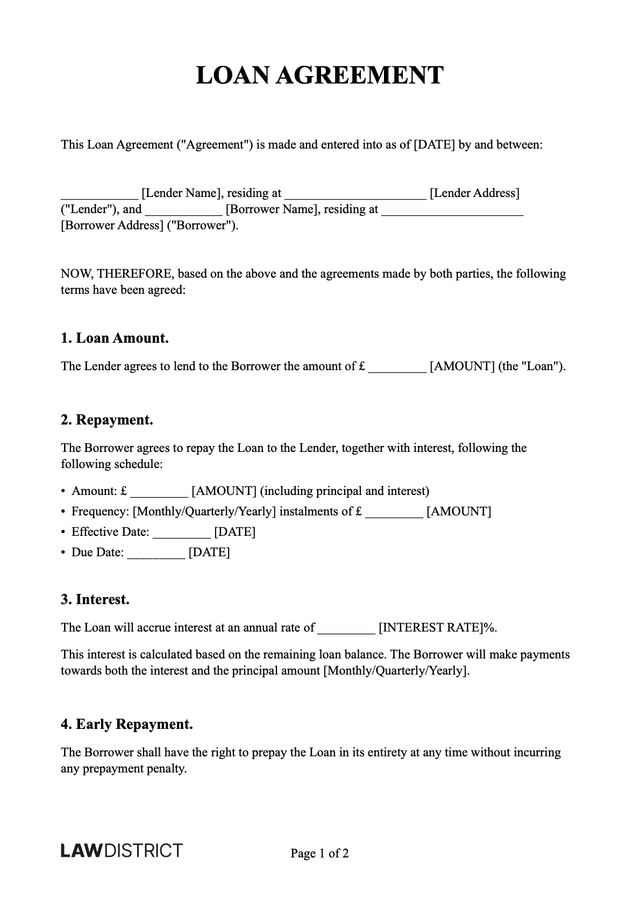
Before drafting your form or filling out your formal Loan Agreement template, reviewing a practical example can be helpful.
The following example Loan Agreement demonstrates the standard terminology and layout required for a valid document.
Terms to include in a Loan Agreement
When you draft your Loan Agreement, you should add several key terms to make certain your document is clear and enforceable.
- Principal and repayment: Define the loan's total amount and the structure of repayments, including frequency and duration.
- Interest: If applicable, state the interest rate and consider whether consumer credit, mortgage, or other regulatory rules apply to the rate.
- Collateral: Detail any assets securing the loan, including registration requirements under the applicable laws.
- Default provisions: Define what would count as failing to meet the loan terms and the actions that can be taken.
- Legal implications: Highlight relevant legal and tax considerations, such as the impact on Inheritance Tax or consider whether the Consumer Credit Act 1974 and FCA rules apply to the loan.
- Signatures*: Sign the agreement. Depending on the applicable laws, you may need a witness for the valid execution of the loan agreement.
These elements serve to protect both the lender's and borrower's interests, making the agreement legally binding and clear on the expectations and obligations of each party involved.
You can use our simple Loan Agreement template as a guide to make sure that you include these clauses in your version of the document.
How to write a Loan Agreement
Creating a Loan Agreement requires careful consideration to ensure it accurately reflects the terms agreed upon by both parties and adheres to legal standards. The structure of a typical personal Loan Agreement requires you to:
- Identify the parties: Clearly state the names and addresses of the lender and borrower.
- Detail the loan: Specify the loan amount and repayment terms, including schedule and duration.
- Set interest rates: If applicable, include interest rate details.
- Define security/collateral: Mention any assets securing the loan.
- Outline default terms: Describe conditions and actions if the borrower fails to repay.
- Ensure legal compliance: Make sure the agreement adheres to relevant laws, including any necessary registrations.
With our basic Loan Agreement template, you can avoid costly mistakes. Make sure your document is solid and accurately reflects the terms agreed on by all parties.
Difference between Secured and Unsecured Loan
Choosing between a secured and an unsecured loan depends on your specific financial situation. This includes your ability to provide collateral, your credit rating, and your borrowing needs.
Compare the features below to decide which loan suits your needs.
| Feature | Secured Loan | Unsecured Loan |
|---|---|---|
| Collateral | Required | Not required |
| Interest Rate | Generally lower | Higher due to increased risk |
| Loan Amount | Can be larger, based on collateral value | Typically smaller |
| Approval Criteria | Relies heavily on value of collateral | Based on creditworthiness and income |
| Risk to Borrower | Risk of losing the asset | No specific asset is pledged as security, although other enforcement remedies may be available, can affect credit score |
| Example | Mortgage, Car Loan | Personal Loan, Credit Cards |
Secured Loan Agreement templates can help you draft a document that aligns with legal standards and includes all the typical elements for this type of agreement.
Do I need to pay fees on a Loan Agreement
Generally, fees depend on the lender, loan type, and transaction. Secured loans have lower fees due to collateral, whereas unsecured loans might carry higher fees that you may need to pay.
Review the specific terms of your Loan Agreement for any mention of origination fees, late payment fees, or other charges. Always clarify these details before signing to avoid unexpected costs.
When getting involved in a Loan Agreement, you should also factor in how this loan impacts your credit score. Fees can vary widely among lenders and loan types, so it's advisable to shop around and negotiate terms.
Key differences in Loan Agreements across the UK
Here’s a quick explanation of the main differences in Loan Agreements across England, Scotland, Wales, and Northern Ireland.
Loan Agreement: Scotland
Scotland has its own legal system with differences in contract and property law. This affects how loan agreements are formed and enforced:
- Governing Law: Scots law doesn’t require “consideration” (exchange of value), so informal loans (e.g., family loans) can be binding without a formal agreement.
- Property & Secured Loans: Scottish property law applies, which can affect how family loans secured by property are handled compared to other parts of the UK.
Loan Agreement: Wales
Wales generally follows English law. However, there are certain regional differences in property laws, particularly when land is involved in secured loans.
- Property & Secured Loans: In Wales, devolved property laws under the Housing (Wales) Act 2014 and the Land Transaction Tax (Wales) Act 2017 can affect mortgages and secured loans.
Loan Agreement: Northern Ireland
Northern Ireland shares many laws with England but has unique limitations for loan enforcement and property regulations.
- Enforcement: Limitation (NI) Order 1989 sets specific time limits for enforcing Loan Agreements, which may differ from those in England and Wales.
Loan Agreement: England
In England, specific rules apply regarding loan formation and enforcement.
- Governing Law: The Limitation Act 1980 generally provides six years for actions founded on simple contract, but there are important exceptions, including certain loans and deeds.
Loan Agreement FAQs
Gain a clearer insight into the workings of Loan Agreements with our frequently asked questions.
Yes, a Loan Agreement is legally binding once both the lender and the borrower enter into a legally valid contract. This document outlines the loan's terms, such as the repayment schedule, interest rate, and any collateral involved, making it enforceable in court.
It serves to protect both parties by clearly defining their rights and obligations, ensuring that there is a formal record of the loan and its conditions.
A fixed sum Loan Agreement refers to a finance contract where the borrower agrees to repay a specified amount of money, which includes both the principal and interest, over a set period.
This type of agreement is commonly used for personal, auto, and home loans, providing a predictable repayment schedule and fixed interest rate throughout the loan term.
It makes it easier for the borrower to manage their finances by knowing exactly how much they need to repay each installment.
To get a Loan Agreement in the United Kingdom, you can use a template to fill out your document. With our template, you can easily fill out the terms and responsibilities that are crucial to protect you and the other party involved.
Once you have your financial document set up, you can have it reviewed by a legal professional to make sure it is ready to put into effect.
Writing a Loan Agreement between friends is an important step to protect both parties and avoid misunderstandings, even when the loan is informal.
A clear agreement should include the amount borrowed, repayment terms, interest (if any), and what happens in case of missed payments.
By putting everything in writing, both parties can stay on the same page without risking the friendship. You should take similar precautions when drafting a Loan Agreement between family members.
Try Lawdistrict Now
Instant and complete access to our entire library of legal forms
Edit, download and print in PDF from any device
Save time and money on legal document creation