
Free Commercial Lease Agreement template

Whether you are renting a retail unit for your shop, an office space, or a building, the terms of your commercial lease may significantly affect your business operations, your financial planning, and your cash flow. Therefore, having a clear and comprehensive commercial lease agreement is vital to the long-term sustainability of your business.

Trusted by 3,276 users.

update icon

Last Update 2 March 2026

check icon

Reviewed by Ali Talip Pınarbaşı, solicitor

Also known as

Business Lease Agreement

Business Lease Contract

Business Property Lease Agreement

Commercial Business Lease Agreement

Commercial Property Lease Agreement

Commercial Property Rental Agreement

Commercial Space Lease Agreement

Fill forms in a few steps

Fill forms in a few steps

Save, print & download

Save, print & download

Done in 5 minutes

Done in 5 minutes

What is a Commercial Lease?

A Commercial Lease Agreement is a legally-binding document signed between a landlord and a tenant; however, unlike a residential tenancy agreement, it is used for rental premises used for business purposes.

This agreement sets out the terms that will apply to the tenant’s occupation of the property, outlines the rights and responsibilities of both parties, and governs other matters such as rent, rent service charges, insurance liability, and restrictions on the use of the property.

Commercial Lease contracts are commonly used for offices, retail spaces, warehouses, and other non-residential properties. The agreement typically includes information related to:

  • Demise or specific part of the property leased to the tenant, such as a retail unit, office floor, or a whole building
  • Rent amount, deposit, service charges and payment schedule
  • Lease duration, break clause and renewal terms
  • Property use restrictions
  • Maintenance and repair responsibilities
  • Provisions for termination or breaches
  • Subletting and assignment of the lease to third parties

Looking for a commercial lease agreement that incorporates all essential terms and protects your interests?

Take advantage of LawDistrict’s free Commercial Lease Agreement template for the UK to help you outline these details when creating your document.

What does a standard Commercial Lease template include?

A standard commercial property lease contains all the necessary terms and clauses to formalise the rental of a business property.

These details make certain that both you and the other party involved understand your rights and responsibilities during the lease period, whether you are a tenant or landlord.

The key elements typically included in a commercial lease in the UK are:

  • Party information: Names and contact information of every party involved.
  • Demise/Property details: This refers to the specific part of the property that is being leased to the tenant, such as a retail unit, office space, or a building. This includes the address.
  • Lease term: Start and end dates of the lease, as well as any renewal options.
  • Payment: The agreed rent amount, value-added-tax (VAT) details, service charges, payment schedule, rent suspension, and any clauses for rent reviews or increases.
  • Accepted uses: The purposes for which the tenant is allowed to use the property.
  • Restrictions and prohibited uses: Prohibited activities such as adult stores or the use of hazardous or dangerous materials in the property.
  • Repair and maintenance obligations: Any responsibilities of the tenant to repair and maintain the property. This should address decorations, internal, and external repairs, and clarify the end-of-term liabilities of the tenant.
  • Insurance criteria: The types of insurance each party must have. For example, in an (FRI) lease, the tenant is usually responsible for repairing the property and reimbursing the landlord for the full cost of building insurance
  • Break clause: Provides an option to end the lease early under agreed conditions.
  • Forfeiture clause: Allows the landlord to terminate the lease at an earlier date if the tenant breaches certain terms, such as late payment of rent or engaging in prohibited uses.
  • Security deposit: The amount required, how it is held, the landlord’s right to make deductions, and the conditions for its return.
  • Subletting and assignment: Terms for any transfer or sublet by the tenant.
  • Guarantees: If there is a personal or company guarantee, you should include it in the lease agreement.
  • Provisions for disputes or breaches: Procedures for dealing with disagreements or violations.

By including these elements, your commercial property rental agreement should be clear and legally sound, as well as tailored to the needs of the business renting the property.

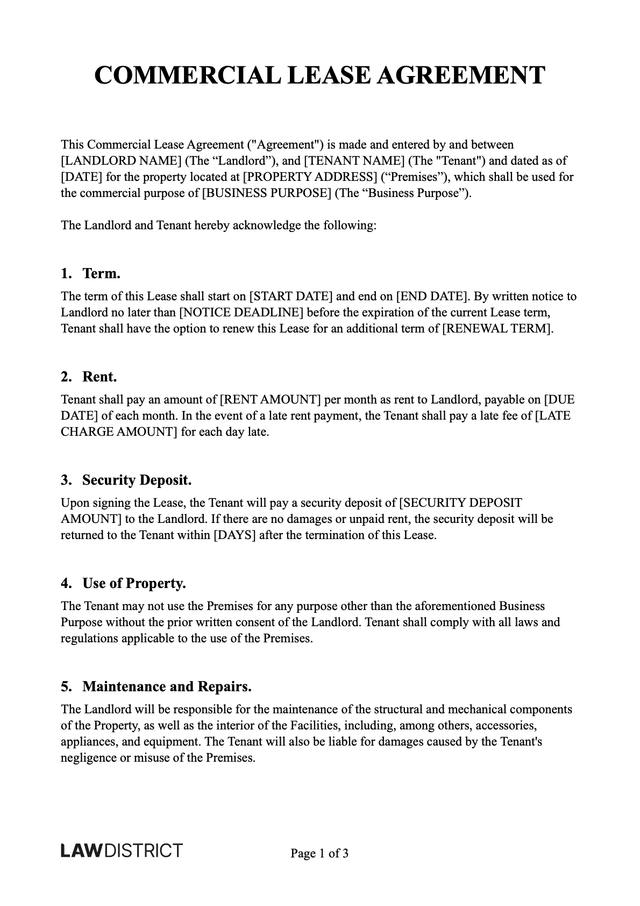
Sample Commercial Lease Agreement in Word & PDF

To help you better understand how your document should be structured, you can review the following example draft lease agreement for a commercial property.

You can also download this Commercial Lease Agreement template in Word or PDF format.
view preview icon
uk-commercial-lease-uk-sample

How to write a Commercial Lease Agreement

Whether you are a landlord or a tenant, drafting a well-structured and comprehensive Commercial Lease Agreement is essential for you to protect your rights and interests and to eliminate risks and unpredictability.

This document must outline all the important terms and conditions of the tenancy to make sure they are clear for both you and the other party involved.

Follow these steps to write a Commercial Lease Agreement in the UK:

  1. List the parties: Start by including the full names and contact details of each party (landlord, tenant, and any guarantor).
  2. Describe the property: Mention details about the commercial property, such as the full address, size, and any specific features or boundaries.
  3. Set the lease term: Include the start and end dates of the tenancy, as well as any renewal options or notice periods for termination.
  4. Outline the rent details: Specify the rent amount, VAT charge, service charges, payment timetable, payment method, and rules for rent increases, rent reviews, or late fees.
  5. Define the accepted use: Mention how the tenant may use the property (e.g., for office, retail, or industrial purposes).
  6. Describe the restrictions and prohibited uses: Provide a list of prohibited or restricted activities, materials, or uses, such as use of the property as an adult store and use after a certain time, like 11 p.m.
  7. Include repair and maintenance obligations: Outline who is responsible for repairs, utilities, and general care of the property.
  8. Add provisions for a break clause: If need be, include a break clause allowing either party to terminate the lease early under specific conditions.
  9. Mention security deposit terms: List the deposit amount, where it will be held, and the conditions for its return at the end of the agreement.
  10. Address guarantees: If there are any guarantees by a company or a person, include them in your commercial lease agreement.
  11. Include clauses on subletting and assignment: State whether the tenant can sublet or assign the lease to another party, and under what conditions.
  12. Detail dispute resolution: Add procedures for resolving disputes, such as mediation or arbitration, and any legal processes for breaches of the agreement.

Once everything is settled and you agree on the terms of your agreement, you must sign it with the other party to put it into effect.

However, note that most commercial lease agreements are executed as deeds, and depending on the length of your commercial lease, you must also register it with the Land Registry.

By following these steps and using our Commercial Lease template, you can create a professional Commercial Lease Agreement that protects everyone involved. Once it’s prepared, you can have a lawyer review it to make sure it’s ready to use.

Commercial Lease FAQs

If you still have any doubts about using or creating a Commercial Lease, we have answered some of the most common questions below.

Review these answers to get any more information you need to set up a Commercial Lease properly.

What rights do commercial tenants have without a lease in the UK?

Without a written lease, commercial tenants may still have some rights under UK law if they occupy the property with the landlord’s consent.

These include protection under the Landlord and Tenant Act 1954. If the arrangement qualifies as a business tenancy and the parties have not contracted out of the Landlord and Tenant Act 1954, a tenant may rely on security of tenure, which can allow the tenant to stay in the property or agree to a new lease.

However, not having a lease leaves terms like rent, notice periods, and responsibilities uncertain, which can lead to disagreements. This is why it’s highly recommended to create a formal agreement in writing.

What happens when a standard Commercial Lease Agreement expires?

When a commercial lease has finished, the tenant must vacate the property unless a renewal has been agreed.

Under the Landlord and Tenant Act 1954, tenants may have the right to request a renewal if the lease is “protected.”

However, if the landlord has legal grounds, the renewal can be rejected. If no agreement is reached, the tenancy ends, and the tenant must leave, unless the protection under the Landlord and Tenant Act 1954 applies.

Who pays the legal fees for a Commercial Lease Agreement in the UK?

In the UK, the responsibility for legal fees in a commercial lease is usually outlined in the lease itself.

Most of the time, the tenant pays for their own legal representation, while the landlord covers their legal costs.

Still, some landlords may ask the tenant to pay part of their legal fees for drafting the lease. It’s important to clarify this during negotiations and ensure the agreement specifically states who are responsible for these costs to avoid misunderstandings.

What are the legal options for early termination of a Commercial Lease in the UK?

Early termination of a commercial lease in the UK could be possible if the lease includes a break clause.

This type of clause allows either party to end the lease on commercial property under specific conditions. As an alternative, tenants may negotiate a surrender agreement with the landlord, but this usually requires mutual consent and may involve a fee.

If neither option is available, early termination without an agreement could lead to consequences, such as compensation claims for breach of contract. Always review the lease terms and seek legal advice before proceeding.

view preview icon
uk-commercial-lease-uk-sample

You are only a few steps away from your own Commercial Lease!


Download our professional examples

Preview of your Commercial Lease

BUSINESS LEASE
THIS LEASE (this "Lease") is dated as of ______________________ (hereinafter, the "Effective Date")

BETWEEN:
_________ of _________
(the "Landlord")

OF THE FIRST PART

AND
_________ of _________
(the "Tenant")

OF THE SECOND PART
IN CONSIDERATION received from the Landlord for leasing certain premises to the Tenant, and the mutual benefits and obligations outlined in this Lease, the Parties to this agreement (referred to as the "Parties") hereby agree to the following terms:
Intent of Lease

1. The Parties to this Lease mutually agree that the rent for this Lease will be based on a gross rent structure, wherein the Tenant will be responsible for paying the Base Rent and any Additional Rent, while the Landlord will bear the responsibility for all other service charges associated with the Premises and the operation of the Building, unless otherwise specified in this Lease.
Let Premises
2. The Landlord agrees to lease to the Tenant the office area referred by the municipality as _________, England (the "Premises"), and which encompasses a Lettable Area of _________ square metres.
3. The Premises shall be utilized solely for the following permitted use: ______________________________________________________________________
__________________________________________________ (the "Permitted Use").
4. As long as the Tenant, or an assignee or subtenant approved by the Landlord, is using and occupying the Premises for the Permitted Use and is not in default under the Lease, the Landlord agrees not to lease any space in the Building to any tenant whose primary business involves the provision of the following services:     ______________________________________________________________________
    ______________________________________________________________________
Term
5. The lease term shall start on _________ at 12:00 noon and shall terminate on _________ at 12:00 noon (the 'Term').
6. The Landlord has the right to terminate the tenancy under this Lease by giving the right number of days notice as required by the law of England if the Tenant fails to observe, perform, and keep any of the covenants, agreements, stipulations, obligations, conditions, or other provisions of this Lease. However, if the Tenant persists in such default beyond the stipulated number of days' notice, the Landlord may terminate the tenancy without further notice.
Security of Tenure
7. The Parties have agreed that sections 24 to 28 of the Landlord and Tenant Act 1954 do not apply to this Lease.

8. The Landlord has served upon the Tenant a notice in the form, or substantially in the form, prescribed by Schedule 1 to the Regulatory Reform (Business Tenancies) (England and Wales) Order 2003 ("the Order").

9. The Tenant has met the requirements of Schedule 2 to the Order by the submission of the prescribed declaration in the form, or substantially in the form, set out in Schedule 2 to the Order.
Rent
10. The Tenant shall pay the Base Rent of £_________, payable per month, for the Premises (the "Base Rent"), without any deduction, abatement, or setoff, subject to the terms of this Lease. The Tenant shall also be responsible for any taxes or fees related to its business.
11. The Tenant will pay the Base Rent on or before the 1st of each and every month of the Term to the Landlord.
12. The Tenant will indemnify the Landlord for all taxes and fees related to the Premises, including appeal costs.
13. All amounts payable by the Tenant under this Lease are exclusive of any Value Added Tax (VAT) that may be payable from time to time, and the Tenant pays any VAT the Landlord can't recover from HM Revenue and Customs.
14. The Landlord retains the right to collect the full amount owed, even if they accept a partial payment from the tenant.
Rent Review
15. If this Lease exceeds five years, the Landlord and Tenant will review the Base Rent every five years, effective at the start of each new five-year period.
16. For any rent review, the Base Rent shall be adjusted to the greater of the immediate preceding Base Rent and the prevailing Open Market Rent.
17. The rent review will assume that:

    a. the Premises are in a condition suitable for a tenant to occupy.

    b. the Premises can be legally rented for the Permitted Use.

    c. the Landlord and Tenant have fulfilled their obligations under this Lease.

    d. If any damage or destruction has occurred to the Premises, it has been fully repaired.
18. The rent review will disregard:

    a. the fact that the Tenant or any previous tenant has occupied the Premises.

    b. any goodwill associated with the Premises due to the Tenant's occupation.

    c. any work done to the Premises that was not required by this Lease.

    d. any activities on, or work done to, any adjoining premises.
19. If the Parties disagree on the new Base Rent, either may request the Royal Institution of Chartered Surveyors president to appoint an arbitrator to determine the Open Market Rent,in arbitration conducted in accordance with the Arbitration Act 1996, binding on both parties.
20. If the arbitrator is incapable or unwilling to act, either party may request the President of the Royal Institution of Chartered Surveyors to appoint a replacement.
21. The results of the rent review will be recorded in a memorandum that both the Landlord and Tenant will sign.
Use and Occupation
22. The Tenant is obliged to fully equip, furnish, staff, and open the entire Premises for public business on the agreed-upon start date of the lease and continuously use and occupy the entire Premises for its business operations throughout the lease term. The Tenant is required to operate its business in a reputable manner on the days and during the hours of business specified by the Landlord.
23. The Tenant agrees to comply with all applicable laws, regulations, and rules set forth by any governmental or regulatory body, whether federal, state, municipal, or otherwise, in relation to the operation of its business on the Premises. The Tenant further agrees not to engage in any activity on or in the Premises that violates any of these laws or regulations.

24. The Tenant agrees to operate and conduct its business on the Premises in compliance with all applicable statutes, including any subordinate legislation currently in force or that may come into force in the future, and any regulations, rules, or orders issued by any government department, local authority, public or competent authority, or court of competent jurisdiction. The Tenant also agrees to comply with any requirements of the insurers relating to the use, occupancy, and enjoyment of the Building, including adhering to proper health and safety practices recommended by all appropriate authorities.
Restrictive Covenants
25. As long as the Tenant or an approved assignee/subtenant occupies the Premises for the Permitted Use and complies with the Lease, the Landlord won't lease space in the Building to tenants competing with the Tenant's primary business, the services of: _________.
Quiet Enjoyment

26. The Landlord promises that as long as the Tenant fulfils their obligations under this Lease, such as paying rent and complying with the terms of the lease, the Tenant will be able to use and enjoy the Premises without any interference or disturbance from the Landlord.
Distress

27. If the Tenant defaults on rent, the Landlord may use the commercial rent arrears recovery (the "CRAR") procedure set out in Schedule 12 (Taking control of goods) of the Tribunals, Courts and Enforcement Act 2007 to have an enforcement agent use its enforcement power to seize and sell the Tenant's goods to recover the outstanding amount.
Holding Over
28. If the Tenant occupies the Premises after the Lease ends without the Landlord's consent, the Tenant will be a month-to-month tenant subject to all of the provisions of this Lease insofar as they are applicable to a month-to-month tenancy, shall continue to apply, and no tenancy from year to year shall be implied by law.
Additional Rights on Reentry

29. If the Landlord re-enters the Premises or terminates this Lease, then:

    a. Even if the lease is terminated and the term becomes forfeited and void, the provisions of the lease that describe the consequences of termination will still apply.
    b. If the Landlord removes the Tenant's property, they may store it at a public warehouse or a place of their choosing, at the Tenant's expense. If the Landlord deems it not worth storing the property, they may dispose of it as they see fit, using the funds towards any Tenant indebtedness. The Landlord is not liable for the disposal, but must provide any remaining proceeds to the Tenant after storage and debts are paid.
    c. The Landlord has the right to relet the Premises or a portion of the Premises for a term that may be shorter or longer than the remaining Term, and may offer reasonable concessions as part of the reletting process, which may include alterations or improvements to the Premises.

    d. The Tenant will pay the Landlord on demand:
         i. all rent, additional rent, and any other amounts owed under the Lease up to the time of reentry or termination, whichever occurs later.
         ii. reasonable expenses incurred or to be incurred by the Landlord in connection with the reentry, termination, reletting, collection of amounts due or payable by the Tenant, seizure, and sale of assets, and any other actions taken by the Landlord as a result of the Tenant's default under this Lease. These expenses shall include but are not limited to, brokerage fees and expenses, legal fees and disbursements, and the expenses of keeping the Premises in good order, repairing them, and preparing them for reletting.
         iii. as liquidated damages, an amount equivalent to the expected loss of rent and other income that the Landlord would have received from the unexpired portion of the Term, if the Lease had not been terminated. The Landlord may opt to receive this amount either:
             I. an amount calculated by the Landlord, based on the present worth of all Base Rent and estimated Additional Rent that would have been payable during the unexpired portion of the Term, discounted at a _________% per annum interest rate. The Landlord may use reasonable estimates of when any such other amounts would have become payable and may make such other assumptions of the facts as may be reasonable in the circumstances.
             II. an amount equal to the Base Rent and estimated Additional Rent for a period of six (6) months.
Insurance
30. The Tenant is not responsible for obtaining insurance coverage for any damage or loss to the Landlord's contents and furnishings in or about the Premises. The Tenant assumes no liability for any such loss.
31. The Tenant is not responsible for obtaining insurance coverage for the Premises against damage or loss to the structure, mechanical or improvements to the Building, and the Tenant holds no liability for any such loss.
32. The Tenant is not responsible for obtaining liability insurance for the Premises and will not be held liable for any loss resulting from the lack of such insurance.
Abandonment

33. If at any time during the Term, the Tenant abandons the Premises or any part of the Premises, the Landlord may, at its option, enter the Premises by any means without being liable for any prosecution for such entering, and without becoming liable to the Tenant for damages or for any payment of any kind whatever, and may, at the Landlord's discretion, as agent for the Tenant, relet the Premises, or any part of the Premises, for the whole or any part of the then unexpired Term, and may receive and collect all rent payable by virtue of such reletting, and, at the Landlord's option, hold the Tenant liable for any difference between the Rent that would have been payable under this Lease during the balance of the unexpired Term, if this Lease had continued in force, and the net rent for such period realised by the Landlord by means of the reletting. If the Landlord's right of reentry is exercised following abandonment of the premises by the Tenant, then the Landlord may consider any personal property belonging to the Tenant and left on the Premises to also have been abandoned, in which case the Landlord may dispose of all such personal property in any manner the Landlord will deem proper in compliance with the Torts (Interference with Goods) Act 1977 and is relieved of all liability for doing so.
Governing Law

34. This Agreement will be construed in accordance with and governed by the laws of England and the Parties submit to the exclusive jurisdiction of the English Courts.
Severability

35. The Parties to this Lease acknowledge that the applicable legislation of England (the 'Act') may take precedence over any provision of this Lease. In the event of a conflict between any provision of this Lease and the Act, the Act will prevail, and the provision of the Lease in conflict will be amended or deleted as necessary to comply with the Act. Furthermore, any provisions required by the Act will be incorporated into this Lease.
Assignment and Subletting
36. The Tenant shall not assign, sublet, or grant any license of the Premises. Any such assignment, subletting, concession, or license, whether by operation of law or otherwise, shall be void and may, at the Landlord's option, result in the termination of this Lease.
Bulk Sale

37. Before conducting any bulk sale of goods and assets, the Tenant must obtain the Landlord's written consent. The Landlord may not unreasonably withhold their consent if the Tenant and the Purchaser can provide the Landlord with assurances, in a form satisfactory to the Landlord, that the Tenant's obligations under this Lease will continue to be performed and respected in a manner satisfactory to the Landlord after the completion of the bulk sale.
Care and Use of Premises
38. The Tenant is required to promptly inform the Landlord of any damage or situation that could significantly disrupt the normal use of the Premises.
39. The Tenant shall refrain from creating or permitting any noise or nuisance that would reasonably disrupt the comfort or convenience of other tenants, as determined by the Landlord.
40. The Tenant is prohibited from participating in any unlawful business or conduct in or around the Premises.

41. The Landlord and Tenant are obliged to adhere to all laws and regulations pertaining to health, sanitation, fire safety, housing, and general safety standards.
Surrender of Premises

42. The Tenant shall vacate and return the Premises to the Landlord at the expiration of the lease term in the same good state and condition as they were at the start of this Lease, except for reasonable wear and tear and damages caused by natural elements.
Hazardous Materials

43. The Tenant is prohibited from keeping or storing any items or materials on the Premises that are hazardous, flammable, explosive, or may significantly increase the risk of fire on the Premises or that may be deemed hazardous by any reputable insurance company. However, if it is necessary for the proper functioning of the business, the tenant may store hazardous materials as long as the Tenant is responsible for adhering to all laws, regulations, and rules concerning dangerous, flammable, or explosive materials and environmental protection. The Tenant shall:

    a. Comply with any applicable laws, regulations, rules, or government authorities, with the Landlord's approval and at its own expense.

    b. Promptly notify the Landlord in writing of any discharge or release of such materials in or around the Premises.

    c. Repair any damage resulting from such discharge or release in or around the Premises, with the Landlord's approval.

    d. At its own cost, obtain a report from an independent consultant verifying the removal or compliance with such materials if requested by the Landlord.
Rules and Regulations

44. The Tenant agrees to abide by all regulations and guidelines posted by the Landlord with regard to the use and maintenance of the Building, car park, and other communal facilities provided for the Tenant's use on the Premises.
General Provisions

45. The Landlord's waiver of any failure by the Tenant to perform or observe the provisions of this Lease will not act as a waiver of the Landlord's rights under this Lease with respect to any future defaults, breaches, or nonperformance. Such waiver will not impede or alter the Landlord's rights concerning any future defaults or breaches in any way.

46. This Lease will remain in effect and be legally binding on and beneficial to the respective heirs, executors, administrators, successors and assigns of each party to this Lease. All obligations and promises contained in this Lease shall be considered as fundamental terms of this Lease.

47. Any amounts due from the Tenant to the Landlord under this Lease will be considered as Additional Rent and can be collected by the Landlord as unpaid rent.

48. If there are multiple Tenants executing this Lease, all of them will be jointly and severally liable for each other's acts, omissions, and liabilities under this Lease.

49. Time is of the essence in this Lease.

50. This Lease represents the complete agreement between the Landlord and the Tenant. No previous understandings or representations of any kind made before the date of this Lease will be binding on either party except as incorporated into this Lease. Specifically, no implied warranties of the Landlord outside of this Lease will be considered.
51. The provisions of Section 196 of the Law of Property Act 1925, as amended by the Recorded Delivery Services Act 1962, will apply to the delivery and service of all notices and other communications pursuant to this Lease.
52. The Parties do not intend for any term of this Lease to confer rights on third parties according to the Contracts (Rights of Third Parties) Act 1999.

53. The Tenant shall be responsible for paying all stamp duty land tax on this Lease and any amending document.
IN WITNESS WHEREOF This Lease has been executed by the Parties on this ________ day of ________________, ________, by affixing their signatures under hand and seal, or by a duly authorised officer under seal executed as a deed.
  
______________________________ 
(Signature of Witness)______________________________
 _________ (Landlord)
______________________________ 
(Print Name) 


______________________________ 
(Signature of Witness)______________________________
 _________ (Tenant)
______________________________ 
(Print Name) 


Try Lawdistrict Now

Instant and complete access to our entire library of legal forms

Edit, download and print in PDF from any device

Save time and money on legal document creation