
Cohabitation Agreement Template UK
A Cohabitation Agreement defines the financial and living arrangements between unmarried partners living together. It can outline how to handle expenses, property ownership, and responsibilities during the relationship or in the event of separation. This can help prevent future legal issues.

Are you living with your partner?
Fill forms in a few steps
Save, print & download
Done in 5 minutes
What is a Cohabitation Agreement?
A Cohabitation Agreement is a legal document created by two people who live together but are not married. It sets out each partner's rights and responsibilities regarding shared property and household expenses.
Sometimes called a living together agreement, these documents are especially useful because unmarried couples do not have the same legal protections as married ones. You may have limited cohabitation rights in the United Kingdom without a written contract.
The document can cover:
- Property ownership
- Contributions to rent or mortgage
- Personal and joint bank accounts
- Asset division
- Care for children
You can use our free Cohabitation Agreement template to help you build a contract tailored to your relationship in the United Kingdom.
When should you use a Cohabitation Agreement?
A Cohabitation Agreement can be useful in many situations where couples want to protect their interests and avoid disputes, such as:
When moving in with another person
When you begin sharing a home with a partner, friend, or another individual, a Cohabitation Agreement can set out how expenses are divided and clarify each person’s share of ownership.
When you are a long-term unmarried couple
A Cohabitation Agreement for unmarried partners is especially important in the UK, where “common law marriage” is not legally recognised. Even long-term couples have limited rights without a written agreement.
A nonmarital Cohabitation Agreement helps reduce the risk of disputes if the relationship ends.
When one partner owns the property
Clarify whether the non-owning partner has any cohabiting rights to the property or is simply contributing to bills.
When sharing financial responsibilities
Use the agreement to set expectations around rent, utilities, and groceries, utilities, and groceries, especially if contributions aren't equal.
When buying assets together
If you’re making joint purchases like a car or furniture, this agreement defines how they will be owned and divided if you separate.
When children are involved
If you are sharing a home with your partner and have children, outlining childcare costs, custody arrangements, and how future decisions will be made in your Cohabitation Agreement checklist is a great way to help prevent misunderstandings in the future.
Cohabitation Agreement free sample
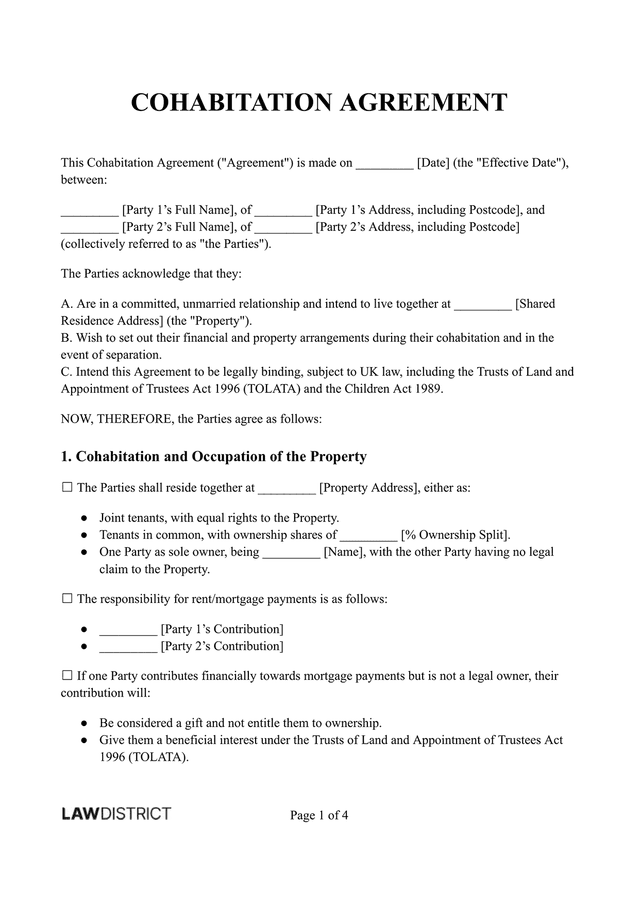
A sample Co-Habitation Agreement can help you decide what sections are relevant to your situation.
By looking at a Cohabitation Agreement example, you can get a better idea of the formal language used and how to structure your own version.
What to include in a Cohabitation Agreement
Below is a list of the information and clauses generally included in a Cohabitation Agreement. You can also use our Cohabitation Agreement template as a guide when drafting your document.
It can help you cover all essential areas while tailoring the document to your specific circumstances in the United Kingdom.
- Define property arrangements: Specify the address, type of ownership, and contributions to rent or mortgage. Specify if payments are gifts or entitle the non-owner to a beneficial interest under TOLATA.
- Outline financial responsibilities: Detail how utilities, council tax, and general expenses will be split. Clarify that each partner remains responsible for their own debts and whether large payments are gifts or loans.
- Include ownership of assets: State who owns pre-cohabitation assets and how jointly acquired items will be divided (equally or proportionally).
- Set financial arrangements: Indicate whether bank accounts are joint or separate. Define contribution amounts and how to split balances in case of separation.
- Plan for separation: Set rules for who stays in the property, financial support obligations, and the process for resolving disputes (mediation or court).
- Determine custody and support of children (if applicable): Include terms for shared custody, visitation, financial support, and dispute resolution under the Children Act 1989.
- Cover wills, inheritance, and legal framework: Confirm the intentions for property and assets, update wills (in accordance with the Wills Act 1837), state which UK legal system applies, and agree to try mediation before legal action.
- Include amendments: Explain that changes must be made in writing and signed by both parties.
- Finalise with signatures: Include full names, signatures, and witness details to validate the document. Your own version of the document should be tailored to your situation.
Then, after you create your document, have a legal expert take a look at it before you sign it to make sure it’s ready to be put into effect.
Also, after you draft your Cohabitation Agreement, you can run it through our free AI legal document reviewer tool if you need to find any specific term or clause at any time.
Cohabitation Agreement FAQs
No, it’s not legally required, but it’s strongly recommended. Without a written Cohabitation Agreement, you risk legal uncertainty. You can think of it as a “living-together agreement”. It covers many issues that could arise when you start living with someone.
For example, if you separate, proving ownership or financial contributions can be difficult. This document protects both partners and avoids misunderstandings.
Yes, Cohabitation Agreements are legally binding if properly drafted and signed. To improve enforceability, both parties should seek independent legal advice. Courts generally uphold these living together agreements unless they are unfair or made under pressure.
Yes. You can update or cancel a Cohabitation Agreement at any time, as long as both partners agree. Any changes must be made in writing and signed. This flexibility allows the agreement to reflect changes in your relationship, finances, or living arrangements.
Use a clear, structured Cohabitation Agreement to protect your rights. A small effort now can prevent major legal problems later.
In the UK, cohabitation is not legally recognised in the same way as marriage or civil partnership. This means couples who are living together do not automatically have financial or legal rights to each other’s property or assets.
That being said, you still have some UK cohabitation rights, which allow you to make agreements that outline property ownership, finances, and parental responsibilities. Without having such agreements in place, your rights are limited to what you individually own or contribute to.
Yes, you can create a Cohabitation Agreement online in the UK. Using our template, you simply enter the details of your living arrangement, finances, and responsibilities.
Once completed, you’ll receive a finished agreement instantly. Both parties can then review and sign the document.
Try Lawdistrict Now
Instant and complete access to our entire library of legal forms
Edit, download and print in PDF from any device
Save time and money on legal document creation