
Stock Transfer Form: J30 & J10 templates
A Stock Transfer Form is a document used to move ownership of shares from one person to another. It helps provide proof of transfer, calculate stamp duty, and guarantee that company records are updated. Use it whenever shares in a UK company are sold or gifted.

Who will be giving up the shares?
Fill forms in a few steps
Save, print & download
Done in 5 minutes
What is a Stock Transfer Form?
A Stock Transfer Form is a document used when you transfer shares in a limited company. It records who is giving up the shares (the transferor) and who is receiving them (the transferee).
The form includes details such as:
- The type of shares
- How many are being transferred
- The consideration paid
This legal document is central to share ownership in the UK. Companies require an instrument of transfer, such as a Stock Transfer Form to update their register of members.
You may also need it for stamp duty purposes if the transfer involves payment. HM Revenue & Customs (HMRC) requires a stamped form when the consideration is over £1,000.
You will usually use a Stock Transfer Form template for fully paid shares. If shares are partly paid, a different form applies. This makes the process clear, avoids disputes, and gives companies the right paperwork to keep their statutory records accurate.
What are J30 and J10 forms?
J30 and J10 forms are two instruments of transfer, used for different situations.
J30 forms
The J30 Stock Transfer Form (often just called the form J30 or share transfer form J30) is used when transferring fully paid shares. Most share transfers in the UK fall into this category.
A Stock Transfer Form J30 is simple to use, as there is no outstanding amount due on the shares being moved.
J10 forms
The J10 form is used when transferring partly paid shares. In this situation, the buyer (transferee) takes on responsibility for any remaining unpaid amount on the shares.
This makes the J10 form less common, but still important when dealing with certain company structures or historic shareholdings.
Stock Transfer Form Sample: PDF & Word
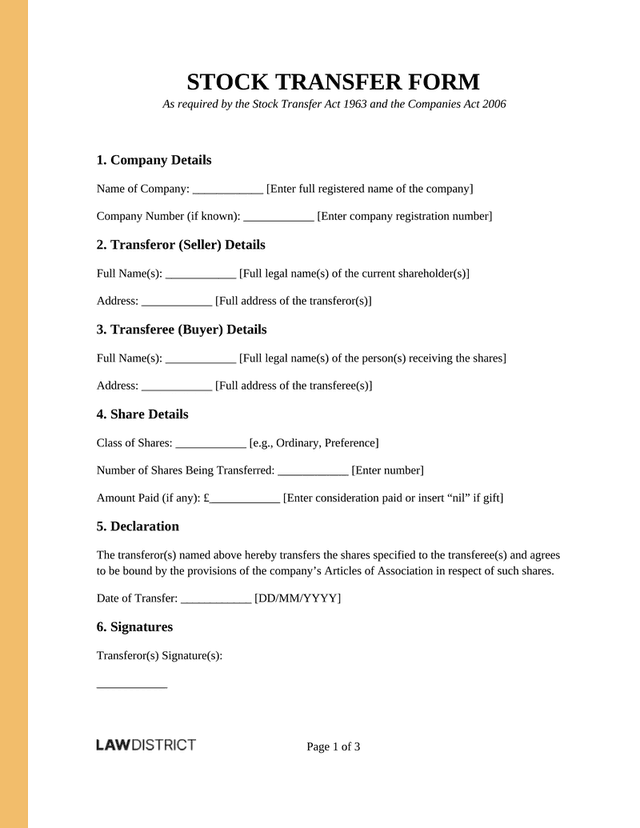
Before you begin drafting, it helps to review a Stock Transfer Form example. You can see how the sections are structured and what information is required.
How to complete a Stock Transfer Form
Knowing how to complete a Stock Transfer Form is key to making sure the transfer is valid. Here are the main elements you should include:
- Details of the company: Full company name and registered number.
- Transferor details: Name and address of the current shareholder.
- Transferee details: Name and address of the new shareholder.
- Class and number of shares: What type of shares are being transferred, and how many.
- Consideration: The amount paid, or “nil” if gifted.
- Stamp duty: applicable if the value exceeds £1,000, in which case the form must be sent to HMRC for stamping.
- Signatures: Signed by the transferor, sometimes by both parties.
Once you complete your form, send it to the company so that they can update their register of members. This is what officially makes the transferee the new shareholder.
You can use our free Stock Transfer Form template to help you draft your own form.
Stock Transfer Form Frequently Asked Questions (FAQs)
Below are some of the most common questions people ask about Stock Transfer Forms in the UK.
A UK Stock Transfer Form must be signed by the transferor (the person giving up the shares). In practice, many companies also ask the transferee to sign to confirm acceptance, although this is not strictly required by law. If the transfer is being registered at HMRC for stamping, the signed original must be submitted.
No. Stock Transfer Forms UK are not filed at Companies House. Instead, they are kept in the company’s own records.
Companies House is only notified when the company files its annual confirmation statement, which must list updated shareholder details. The form itself remains part of the company’s private paperwork.
A stock transfer agent is a third party that helps manage share transfers, record keeping, and shareholder services on behalf of a company. They are more common in public companies than in private limited companies.
For small private companies in the UK, share transfers are usually handled internally by the company secretary or directors.
No. A Stock Transfer Form UK does not need to be executed as a deed. It is a simple instrument, and only the signature of the transferor is required. However, accuracy is vital. Errors or missing information can delay registration or create disputes over ownership.
Try Lawdistrict Now
Instant and complete access to our entire library of legal forms
Edit, download and print in PDF from any device
Save time and money on legal document creation