
Lodger Agreement Template UK
A Lodger Agreement allows you to set out your rules when renting out a room in your home. It covers important aspects like payments and day-to-day living arrangements. This agreement can help you avoid potential conflicts from the start.

The property is a:
Fill forms in a few steps
Save, print & download
Done in 5 minutes
What is a Lodger Agreement?
A Lodger Agreement is a legally binding agreement form between a homeowner (or “landlord”) and a lodger, outlining the terms under which the lodger rents a room or shares the facilities in the property.
Unlike full tenancy agreements, Lodger Agreements are used when the owner lives in the property, making it a shared space.
Lodger tenancy agreements are essential to clarify the expectations and responsibilities of each party, helping to prevent misunderstandings and disputes.
Understanding the importance of having a clear, comprehensive Lodger Agreement in place protects your property rights and ensures the lodger pays on time.
Lodger Agreement vs Tenancy Agreement
It's important to distinguish between a lodger and a tenant to understand the difference between these legal documents, and how to address the other party:
| Lodger | Tenant |
|---|---|
Someone who lives in a property where the landlord also lives and usually shares spaces such as the kitchen, bathroom, or living room. A lodger does not have exclusive possession and typically has more limited rights. | Someone who rents a property or part of a property with exclusive possession of their space. A tenant has stronger legal protections, including deposit protection and protection from eviction without a legal process. From May 2026, most private tenants in England also benefit from increased security, such as the end of “no-fault” evictions. |
Whether an arrangement is a tenancy or a licence depends on the specific facts of the letting rather than the label used in the document.
These differences affect the rights and obligations of both parties. This is why it’s crucial to choose the correct agreement type for your specific situation.
The Renters’ Right Act reforms of May 2026 usually do not apply to lodgers. Rules on Section 21 and assured periodic tenancies are aimed at private tenants. They do not apply to standard resident-landlord lodger arrangements.
Note: You may sometimes see a Lodger’s Agreement referred to as a lodger tenancy agreement, a live-in landlord tenancy agreement or a room rental agreement. Make sure you fully understand all aspects of the agreement before signing any legal document.
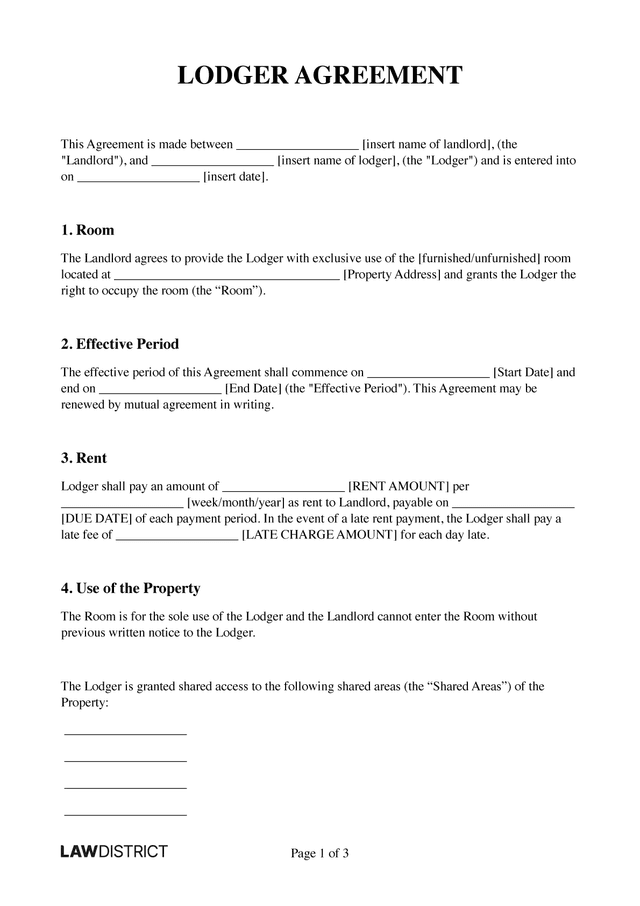
Lodger Agreement sample
It’s useful to review a completed Lodger Agreement example before starting yours.
Below you’ll find an example of a completed Lodger Agreement.
What should be included in a Lodger Agreement?
Your Lodger Agreement should include the following information. Make sure to include everything, as missing information can expose you to financial loss and legal disputes.
- Personal details: Names and contact information of the landlord and lodger.
- Property details: The address of the property and a description of the room or space provided to the lodger, and shared areas the lodger will have access to.
- Rent and deposits: Amount of rent, payment frequency, and any deposit taken.
- House rules: Guidelines on guests, pets, smoking, noise, and other aspects of living together.
- Utilities and bills: How utility bills are split or if they are included in the rent.
- Duration and notice period: The length of the agreement and how much notice must be given to terminate the agreement by either party.
- Lodger's and landlord's responsibilities: Maintenance, cleaning, and other responsibilities.
- Landlord’s right to enter: Under what conditions a landlord may enter the lodger’s space.
By using a free Lodger Agreement template, you can be confident that all these key elements are covered without the hassle of drafting a document from scratch.
How to write a Lodger Agreement
You can easily create an agreement between a lodger and landlord using our free UK Lodger Agreement template. Simply follow these steps:
- Access our template: Get started with our online form.
- Add personal details: Fill in the personal details of both the landlord and the lodger, including names and contact information.
- Provide property description: Clearly describe the room being rented out and any shared areas of the property.
- Outline rent and deposit: Specify the amount of rent, the payment schedule, and any deposit required.
- Define house rules: Outline any rules regarding guests, pets, smoking, noise, and use of common areas.
- Specify utilities and bills: Clarify how utilities and bills will be handled, whether they are included in the rent or split between the landlord and lodger.
- Add duration and notice period: Define the length of the agreement and the notice period required for ending the agreement.
Writing a Monday to Friday Lodger Form
A Monday to Friday Lodger Agreement is used when the lodger only occupies the room during weekdays, rather than on a full-time basis.
Unlike a standard Lodger Agreement, this type of arrangement should specify:
- Access restrictions at weekends
- How rent reflects reduced occupancy
- Whether utilities are included on non-occupancy days
Setting these differences out clearly helps manage expectations and prevents disputes later on.
Possible restrictions to include in a Lodger Agreement
Lodger Agreement templates often include various restrictions to guarantee clear boundaries between the homeowner and the lodger. These might cover:
- Access to specific areas: Restricted access to certain rooms or spaces like the homeowner’s bedroom or private office.
- Use of amenities: Limited use of certain appliances, parking spaces, or outdoor areas.
- Guest policies: Rules should be set for the lodger to have overnight guests or limit visitor access to common areas.
- Noise and activities: Imposing quiet hours or restricting loud activities to avoid disturbing others.
- Storage: Defining designated storage spaces for the lodger’s belongings.
Including these restrictions in your own “rent-a-room” agreement helps prevent disputes over common areas and noise.
Lodger’s rights
When you invite someone to rent a room in your home, you must understand that they have certain rights that must be respected:
- Right to a safe and well-maintained living environment: Landlords must ensure that amenities are well-maintained and repairs are carried out promptly.
- Right to privacy: Landlords must respect the lodger’s right to privacy within their rented room and agree to terms regarding access.
- Right to reasonable notice before eviction: Depending on the arrangement, the lodger may have the right to notice before eviction. The exact notice period should be clearly stated in the Lodger Agreement.
- Protection from unfair eviction and harassment: Any action to remove a lodger must be in accordance with the agreement and relevant laws.
A comprehensive Lodger Agreement ensures that these rights are clearly understood by both parties.
Can you evict a lodger immediately?
The process of evicting a lodger is generally more straightforward than evicting a tenant, primarily because lodgers do not have the same level of protection under UK housing law.
Unlike the requirement to obtain a court order to evict a tenant, the eviction of a lodger usually does not require a court order.
However, lodgers still have rights, and certain procedures must be followed to ensure an eviction is lawful and fair.
The key factor in evicting a lodger is the notice period, which should be clearly stated in the Lodger Agreement. Lodgers are generally entitled to “reasonable notice” which is considered to be equal to the rent payment period.
This typically correlates with the rent payment schedule:
- Weekly rent payments: At least 1 week's notice.
- Monthly rent payments: A month's notice.
These periods are essential for ensuring that the eviction process is fair and gives the lodger a reasonable time to find alternative accommodation.
Lodger Agreement rules across the UK
Lodger rules are broadly similar across the UK, but the legal terms and official guidance differ by country:
| Country | Main difference to know |
|---|---|
| Scotland Tenancy Agreement rules | Scotland uses different terminology to England. If someone lives with their landlord, Shelter Scotland says they will usually have a common law tenancy, not a standard private residential tenancy. |
| Wales Tenancy Agreement rules | Wales has its own Renting Homes system. Many tenants and licensees are known as contract-holders, and landlords may need to give a written occupation contract. You should check if your lodger arrangement falls under these rules. |
| Northern Ireland Tenancy Agreement rules | nidirect clearly states that if you let part of your home and also live there, the people sharing your accommodation are lodgers, not tenants. It also highlights extra points such as equality rules, the Rent a Room Scheme and tourist accommodation certification. |
Limitations of Lodger Agreement templates
Despite offering a convenient option to landlords who need a quick, basic template, any pre-made free Lodger Agreement templates have their limitations. They can sometimes suffer from generalised language that may not fully address your specific circumstances.
For example, unique rules about shared spaces or payment methods might not be covered. Critical details that you will want to specify, such as how deposits will be handled or the process for modifying the agreement, might be missing.
It’s a good idea to use a Lodger Agreement form as a starting point, but customise it to fit your situation in order to overcome these limitations. This is made easier with Lawdistrict. Our platform offers a range of benefits, including:
- Complete customisation of your Lodger Agreement pdf to guarantee compliance and avoid disputes
- Full, instant access to all customisable legal documents
- The ability to edit, download, and print your agreements with ease
- Secure cloud storage to access your documents anytime, anywhere
- Unlimited downloads to create as many agreements as you need
Lodger Agreement FAQs
In this section we answer commonly asked questions about Lodger Agreements in the UK.
Yes, a Lodger Agreement is a legally binding contract once it has been signed by both the landlord and the lodger.
This agreement not only outlines the terms and conditions of the lodging arrangement but also legally enforces these terms.
A Lodger Agreement provides a framework within which both parties agree to operate. Ensures that both the landlord's and the lodger's rights and responsibilities are clearly defined and protected under law.
Yes, a lodger can claim Universal Credit to help with housing costs if they are liable to pay rent. However, entitlement depends on his/her specific circumstances.
The ability for a lodger to claim housing benefits depends on their individual circumstances, including their income, savings, and eligibility for benefits.
Lodgers on a low income or who are receiving certain benefits may qualify for housing benefit to help cover some or all of their rent. Any income from lodging must be declared and may affect the amount that can be claimed.
In most cases, new claims are made through Universal Credit rather than Housing Benefit. Housing Benefit is now largely limited to pensioners and people living in some types of supported housing.
It's advisable for lodgers to check their eligibility with their local council.
The changes typically do not apply to Lodger Agreements in 2026. In England, the changes from 1 May 2026 are aimed only at private tenants with assured or assured shorthold tenancies.
If you are a lodger living with your landlord, those changes will not apply.
Try Lawdistrict Now
Instant and complete access to our entire library of legal forms
Edit, download and print in PDF from any device
Save time and money on legal document creation