
Zero-Hour Contract Template (UK)

In the UK, a Zero-Hour Contract allows employers to hire staff with no guaranteed hours. They provide flexibility for both employer and worker in industries such as retail, hospitality, and seasonal work.

Trusted by 7,318 users.

update icon

Last Update 18 November 2025

Fill forms in a few steps

Fill forms in a few steps

Save, print & download

Save, print & download

Done in 5 minutes

Done in 5 minutes

Zero-Hour Contract meaning

A Zero-Hour Contract is a legal contract between an employer and a worker. The employer does not have to offer hours, and the worker does not have to accept them.

This type of legal document is often used where demand for staff changes from week to week. Employers benefit from a pool of available workers, while individuals gain flexibility to accept or decline work based on their availability.

Despite its flexibility, a Zero-Hour Contract is still a legal employment agreement. Workers engaged under this type of contract are entitled to many statutory rights.

These include:

  • The national minimum wage
  • Paid annual leave
  • Rest breaks

The contract also serves as a written record of the working arrangement. It’s used to set out pay, duties, and conditions of the contract.

How do Zero-Hour Contracts work?

In practice, a Zero-Hour Contract operates by offering work on an “as needed” basis. The employer contacts the worker when hours are available. The worker may then choose to accept or decline.

Each shift or assignment agreed is treated as a short-term arrangement under the broader Zero-Hour Contract. Payment is made for the actual hours worked, at or above the national minimum wage.

The arrangement remains ongoing until ended by either party. However, many contracts include a termination clause.

Zero-Hour Contracts are especially common in industries with fluctuating staffing needs, such as:

  • Seasonal retail
  • Event management
  • Healthcare cover

You could also use it to hire someone who needs work that fits around studies or family commitments.

Zero-Hour Contract rights in the UK

Workers on a Zero-Hour Contract have statutory rights under UK employment law. The key rights include:

  • National minimum wage and national living wage: All hours worked must be paid at or above the current rate
  • Paid holiday: Workers accrue paid annual leave. This is calculated as [12.07% of the actual time worked) in a pay period.
  • Rest breaks: Rights to daily and weekly rest periods and breaks during shifts also apply under the Working Time Regulations.
  • Protection against discrimination: Workers are also protected under the Equality Act 2010.
  • Right to work elsewhere: Since 2015, exclusivity clauses in Zero-Hour Contracts have been unenforceable under the Small Business, Enterprise and Employment Act 2015, Part 2A.

It is important to note that many individuals on a Zero-Hour Contract will have “worker” status rather than full “employee” status.

This means they may not get redundancy pay or be able to claim unfair dismissal. They could qualify if their work pattern shows a more permanent job.

Employers must also provide a written statement of terms (or contract) setting out the conditions of work, pay, and other key details from day one of employment, as required under the Employment Rights Act 1996.

Zero-Hour Contract example PDF & Word

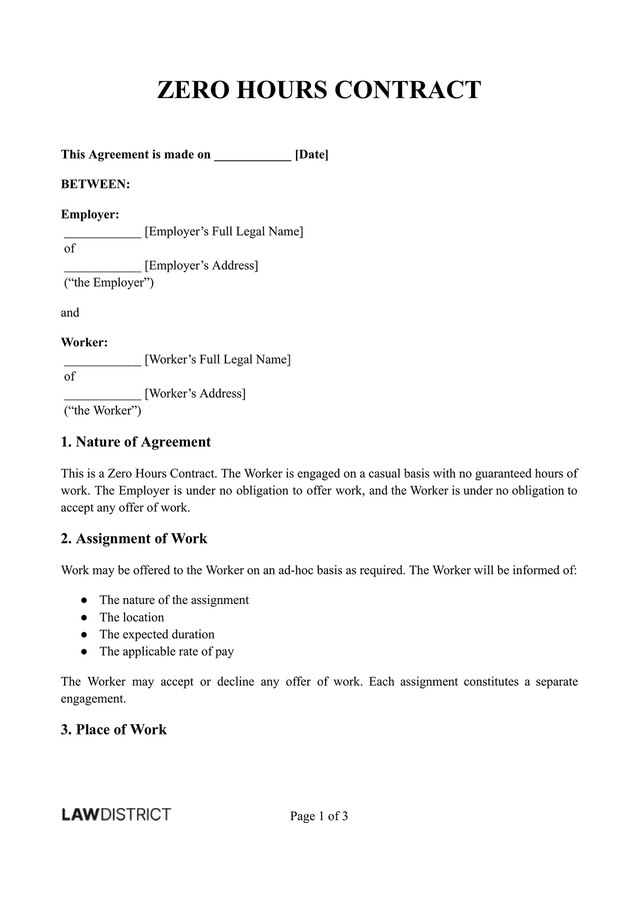
Before preparing your own Zero-Hour Contract, it is helpful to review a sample. The Zero-Hour Contract example below shows you the typical structure and common clauses.
view preview icon
uk-zero-hours-contract-sample

Advantages and disadvantages of Zero-Hour Contracts

Zero-Hour Contracts can be useful for both employers and workers, but they may also bring some challenges. Understanding the pros and cons helps you decide if this type of contract suits your hiring needs.

Advantages of Zero-Hour Contracts

Advantage Explanation
Flexibility for employers Employers can adjust staffing levels quickly to meet fluctuating demand without committing to fixed hours.
Flexibility for workers Individuals can choose when to accept work, fitting shifts around study, family, or other jobs.
Entry-level opportunities Provides a way for workers to gain experience, particularly in industries with high turnover.
Cost-effective staffing Employers only pay for hours worked, helping manage budgets in seasonal or unpredictable markets.

Disadvantages of Zero-Hour Contracts

Disadvantage Explanation
Unpredictable income Workers may not know how many hours they will get, making budgeting and financial planning difficult.
Lack of guaranteed hours No obligation on the employer to offer work can lead to insecurity for workers.
Limited employment rights Some protections, such as redundancy pay and unfair dismissal, may not apply unless regular work establishes employee status.
Work–life balance issues Shifts can be offered at short notice, making it harder for workers to plan ahead.

Zero-Hour Contracts FAQs

Still have some doubts? Here are the answers to some of the most common questions people have about using Zero-Hour Contracts in the UK.

Can zero-hour workers refuse to work?

Yes. A core feature of a Zero-Hour Contract is that workers can decline shifts or assignments offered. There is no obligation to accept work, and employers cannot penalise a worker for refusing.

This flexibility is what makes the arrangement attractive to many people, although it can mean less predictable income.

Are Zero-Hour Contracts legal in the UK?

Yes. Zero-Hour Contracts are legal under UK employment law and widely used in industries where demand fluctuates.

However, certain protections apply: exclusivity clauses are banned, and workers must still receive the national minimum wage, paid holiday, and rest breaks.

Government guidance confirms that these contracts must be used fairly. They cannot be used as a way to avoid giving statutory rights.

When do Zero-Hour Contracts end?

A Zero-Hour Contract continues until it is terminated by either the worker or the employer. Some contracts include a notice period for clarity. If this is not stated in the document, general employment law applies.

Employers may also treat the contract as ended if no work has been offered or accepted for a prolonged period. This clause should be made clear in the terms.

view preview icon
uk-zero-hours-contract-sample

You are only a few steps away from your own Zero Hours Contract!


Download our professional examples

Preview of your Zero Hours Contract

Zero Hours Contract
_________
_________
1. _________ a company incorporated in England and Wales with registered number _________ whose registered office is located at _________ (the Business, we or us); and
2. _________ of _________ (the Worker or you).
Dear _________,
      _________ (the "Business") engages casual workers due to fluctuating demand, which makes it difficult to anticipate staffing needs at all times. This letter sets out the terms under which the Business agrees to establish a casual working relationship with you. The start date is _________.
Nature of This Agreement
1. This agreement sets out all terms agreed between you and the Business concerning your occasional work for the Business. It is not a contract of employment and does not confer employment rights, except for those applicable to workers. The Business is under no obligation to offer you work, and by signing this agreement, you acknowledge that no guarantee is made regarding the amount or regularity of work or working hours. You will work on a flexible basis, as and when needed. Both you and the Business intend that no mutual obligations exist between you and the Business during periods when you are not engaged in work.
Offering and Performance of Work
2. The Business retains full discretion over whether to offer work to you or to any other individual. There is no obligation on the Business to provide work at any time, nor is it required to give reasons for its decisions.
3. Each assignment of work offered to you is treated as a separate engagement (an "Assignment"), and no ongoing relationship exists between you and the Business between Assignments. The fact that work may be offered on one or more occasions does not grant you any legal entitlement to ongoing or regular work, nor does it create continuity of employment.
4. All work you undertake for the Business will be subject to the terms set out in this letter, unless the Business notifies you otherwise in writing.
5. If the Business wishes to offer you work, it will do so by contacting you via email or telephone. You are under no obligation to accept any offer of work made by the Business at any time.
6. You are welcome to enquire about available work by contacting us via email or telephone.
7. Once you accept an Assignment, the Business will expect you to carry it out in full.
8. If you accept an Assignment, you must inform the Business immediately if you are unable to complete it for any reason. If an Assignment is not completed, you will be paid on an hourly basis for the hours you have worked.
9. If the Business needs to cancel an Assignment, it will provide you with notice as soon as reasonably practicable.
10. The Business reserves the right to end any work you are undertaking at any time due to operational needs.
11. You will be paid for all work completed up to the point at which the Assignment is terminated. If the Business cancels work you had agreed to undertake and fails to inform you before you arrive at the place of work, you will be reimbursed for any reasonable travel expenses already incurred.
Type of Work
12. The Business may from time to time offer you work in the role of _________. If you accept an offer, your duties are expected to include _________. The nature of the work may vary with each Assignment, and you may be asked to perform other tasks as required to support business needs. You will be informed of the specific duties at the start of each Assignment.
13. Before any work can be offered, the Business must review certain original documents to confirm that you have the legal right to work in the UK. Further details will be provided to you by the Business. You confirm that you currently have the right to work in the UK without requiring additional immigration permission, and you agree to notify the Business immediately in writing if your entitlement changes at any time for any reason.
Compensation
14. You will be paid only for the hours you attend work, as agreed in advance and outlined in clause 2. The current hourly rate for casual workers is £_________ (gross). Payment will be made monthly in arrears, on or around the 1st of each month, directly into your bank account for hours worked during the previous month. The Business will make all legally required deductions from your pay, including pension contributions under the auto-enrolment scheme where applicable. The Business also reserves the right to deduct from your wages, or any other sums due to you, any amount you owe to the Business at any time.
Work Location, Hours and Holiday
15. The Business may offer you work at different locations. You will be informed of the specific place of work prior to the start of each Assignment.
16. Your working hours will vary according to the Business’s needs. You will be informed of the expected hours prior to the commencement of each Assignment.
17. If you are required to work more than six hours in a single day, you will be entitled to a one-hour unpaid lunch break.
18. Your holiday entitlement will be calculated based on the actual hours you work and pro-rated from a full-time entitlement of 28 days per holiday year (inclusive of the standard eight public holidays in England and Wales). The Business’s holiday year runs from 1 January to 1 January.
19. If, at the end of an Assignment, you have taken more holiday than you have accrued, the Business may deduct from any sums owed to you an amount equal to one day's pay for each excess day taken. A day's pay will be calculated based on your average daily hours multiplied by your current hourly rate.
Working Time Opt-Out
20. If you intend to work more than 48 hours per week, you must complete the Business’s Working Time Opt-Out Letter Agreement to confirm your decision to opt out of the 48-hour weekly limit. If you do not opt out, you will be restricted to working no more than 48 hours per week. You are required to keep the Business informed of any hours worked for third parties, to ensure compliance with this obligation.
Absence Due to Sickness
21. If you are unable to attend work for any hours you have agreed to, you must notify us no later than 30 minutes before your scheduled start time, explaining the reason for your absence.
22. If you meet the legal qualifying conditions, you will be entitled to receive Statutory Sick Pay (SSP) for any period of illness or injury that falls within agreed working hours. No additional payments will be made by the Business during such periods.
Data Oversight
23. The Business will process your personal data and sensitive personal data (“special categories of personal data”) in accordance with its Data Protection Policy and Privacy Notice, which are available upon request or in the Staff Handbook.
24. "Personal data" includes items such as references, personnel records, emails containing personal information, home addresses, and details of contractual benefits.
25. "Sensitive personal data" includes information about:
      a. Your health, for the purpose of monitoring sickness absence and making decisions regarding your fitness to work.
      b. Your racial or ethnic origin, religion, or similar information, to monitor compliance with equal opportunities legislation.
26. You will comply with your responsabilities under our Data Protection Policy and other relevant policies.
27. Your data will be processed in line with our Data Protection Privacy Notice, specifically for the following purposes:
      a. Fulfil our obligations under your contract.
      b. Ensure compliance with our legal obligations.
      In other instances, we have a legitimate interest in processing your data before, during, and after the conclusion of the business relationship.
28. The Business may transfer personal data and sensitive personal data outside the UK or the European Economic Area (EEA), in line with its Data Protection Privacy Notice.
Confidential Information
29. You must not use or disclose any confidential information to any person, either during or after your time working for the Business. "Confidential information" refers to any information or matter not publicly available that concerns the Business or its business contacts. This restriction does not apply to:
      a. Prevent you from making a protected disclosure as defined under section 43A of the Employment Rights Act 1996.
      b. Use or disclosure that has been authorised by the Business, is required by law, or arises in the proper performance of your duties.
Business Rules and Procedures
30. Throughout each Assignment, you are required to comply at all times with the Business’s rules, policies, and procedures as may be in effect from time to time.
Business Property
31. All documents, hardware, and software provided to you by the Business, as well as any data or documents (including copies) created, stored, or maintained on the Business’s computer systems or other electronic devices (including mobile phones), remain the property of the Business.
32. All Business property in your possession, including any original or copied documents obtained during the course of your work, must be returned upon request and always at the end of each Assignment.
Termination
33. If you no longer wish to be considered for casual work with the Business, you should notify us in writing at the earliest opportunity.
34. The Business reserves the right to terminate this agreement immediately in writing if it reasonably believes that you have committed a serious breach of its terms or an act of gross misconduct. Examples of gross misconduct may include, but are not limited to, dishonesty, theft, physical altercations, misuse of drugs or alcohol, or any other actions or omissions likely to bring the Business into disrepute.
Changing Terms and Conditions
35. The Business reserves the right to update the terms under which it offers casual work by issuing written notice to terminate this contract with immediate effect. At its absolute discretion, the Business may offer you a new casual work contract. If this contract is terminated, you will only be entitled to any outstanding wages and accrued holiday pay, with no further payments due.
Entire Agreement
36. This contract accurately reflects the intentions, expectations, and all agreed terms between both parties relating to your work with the Business. Any amendments to this contract will only be valid if made in writing and signed by both parties. You confirm that you have read and fully understood this document and have had the opportunity to seek advice where needed.
Governing Law
37. This agreement shall be governed by and interpreted according to the law of England and Wales and all disputes arising under the agreement (including non-contractual disputes or claims) shall be subject to the exclusive jurisdiction of the English and Welsh courts.

______________________________________
_________ for and on behalf of _________

______________________________________
Date of signature

______________________________________
_________

______________________________________
Date of signature
Try Lawdistrict Now

Instant and complete access to our entire library of legal forms

Edit, download and print in PDF from any device

Save time and money on legal document creation