
Free NDA (Non-Disclosure Agreement) template
If you’re a business owner, entrepreneur, or consultant, an NDA guarantees that sensitive information stays private.

Fill forms in a few steps
Save, print & download
Done in 5 minutes
What is an NDA (Non-Disclosure Agreement)?
An NDA, or Non-Disclosure Agreement, is a legally binding contract designed to prevent the unauthorised sharing or misuse of confidential information.
The primary function of this legal document is to ensure that the recipient of sensitive details agrees not to disclose or misuse the information provided.
NDAs are commonly used in situations where trust is essential, such as when:
- Discussing intellectual property for product development
- Negotiating business partnerships and joint ventures
- Onboarding employees with access to company secrets
- Sharing sensitive business information with vendors and suppliers
NDAs not only protect sensitive business information and trade secrets, but they also establish clear expectations between parties.
The Non-Disclosure Agreement emphasises its role in fostering secure collaboration. Should a breach occur, the injured party has legal recourse. This can include seeking damages, specific performance or court injunctions to prevent further misuse of the information.
For further guidance, visit the UK Government’s Guide on Intellectual Property, which outlines rights and protections for businesses and individuals.
How to write an NDA
Drafting an NDA that aligns with your specific needs requires precision. Here’s how to structure a comprehensive agreement:
- Identify the parties: State the full legal names and roles of the discloser and recipient to clarify who is bound.
- Define confidential information: List what qualifies as "Confidential Information," covering all formats (e.g., written, oral, or digital) and excluding publicly known data or independent knowledge.
- Set obligations: Specify the Recipient’s restrictions on disclosure and use, limiting access to authorised employees tied to the agreement’s purpose.
- Requiring the recipient to take appropriate measures: You should clarify that the recipient must take all appropriate technical, organisational and contractual measures to ensure the ongoing confidentiality of the disclosed information.
- Include exclusions: List exceptions, like information that is public, legally disclosed by a third party, or known before signing.
- Determine duration: State the NDA’s term, fixed (e.g., five years) or indefinite, for trade secrets until public disclosure.
- Address breaches: Outline penalties for breaches, including financial damages and legal injunctions for irreparable harm.
- Return of materials: Require all confidential materials to be returned, deleted, or destroyed on request, with written confirmation.
- Clarify the purpose: Explicitly define the purpose (e.g., evaluating a business relationship) to restrict use. You should also clarify that the information cannot be used for any other purposes without prior written consent to avoid unauthorised use.
- Include data protection: Address compliance with data laws like UK GDPR, ensuring secure processing and breach notifications.
- Intellectual Property: Specify your IP rights over the disclosed information, such as your ownership of all patents, copyrights, trademarks, trade secrets and other applicable intellectual property rights over the disclosed material.
- Applicable law and jurisdiction: If the recipient is in a foreign country, enforcing the breaches of the NDA might be more challenging. Therefore, you need to choose a governing law and jurisdiction that is most convenient to you.
- Assignment: Ensure that the recipient cannot assign the contract to a third party without your written consent.
These steps ensure your NDA mirrors the provided agreement and offers comprehensive protection. Once you’ve finished your NDA, it’s a good idea to have a legal professional revise it to make sure it meets legal standards.
Non-Disclosure Agreement template sample (Word & PDF)
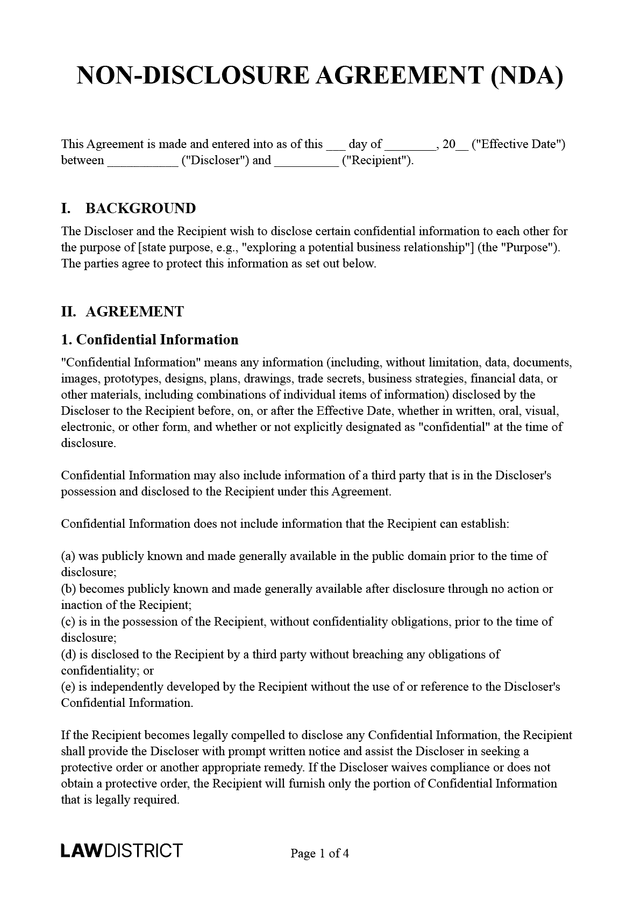
You can simplify the drafting process by using a Non-Disclosure Agreement template. Customisable templates provide a reliable starting point, ensuring all essential clauses are included.
Below is an example of a typical NDA:
Different types of Non-Disclosure Agreements
Not all NDAs are the same, and choosing the correct type guarantees your agreement aligns with your needs. Here are the main types of NDAs:
- Unilateral NDAs: These are one-way agreements where only one party discloses confidential information. They are commonly used when an employer shares proprietary information with employees or contractors.
- Mutual NDAs: These agreements involve both parties sharing sensitive information and agreeing to keep it confidential. They are ideal for business partnerships or joint ventures.
- Multilateral NDAs: These agreements cover three or more parties. For example, in a project with multiple stakeholders, a multilateral NDA ensures all parties are bound by the same confidentiality terms.
If you're unsure which type suits your situation, consider consulting a legal professional.
Related documents
Non-Disclosure Agreement FAQs
Do you still have some questions about NDAs? Here are the answers to some of the most common questions people have before they draft their document.
What happens if you break an NDA depends on the terms outlined in the agreement and the severity of the breach. Common consequences include financial damages to compensate the injured party or legal injunctions to stop further disclosures.
In extreme cases, criminal charges may apply if insider trading laws or court injunction orders are violated.
The duration of an NDA is typically specified in the document. Some agreements last for a fixed term, such as three or five years, while others are indefinite, especially when protecting trade secrets.
How long you want your NDA to last should be determined based on the nature of the information being safeguarded. For instance, financial reports may need short-term protection, while proprietary designs might require indefinite confidentiality.
If a party refuses to sign an NDA, it often signals a lack of trust or reluctance to commit to confidentiality. Without an NDA in place, the disclosing party risks exposing sensitive information without legal protection.
In such cases, consider negotiating the terms to address concerns or exploring alternative legal safeguards, such as non-compete clauses or verbal agreements, though these are less enforceable.
Yes, an NDA is legally binding under UK law as long as it meets basic contract requirements, including mutual agreement, lawful purpose, and consideration (something of value exchanged).
For an NDA to hold up in court, it must be clear and specific, and it should not impose unreasonable restrictions.
To ensure enforceability, use a legally compliant free non-disclosure agreement template and consult legal resources like the UK Government’s Overview of Contracts.
Using a reliable NDA template, UK entrepreneurs, business owners and consultants can protect their sensitive information and foster trust in professional relationships.
While breaching an NDA is typically a civil matter, severe breaches involving criminal actions, such as insider trading or disregarding a court injunction related to an NDA, can lead to jail time.
In most cases, breaking an NDA results in financial penalties or injunctions rather than imprisonment. It’s important to understand the terms of the agreement and the potential legal consequences to avoid escalation to criminal proceedings.
Try Lawdistrict Now
Instant and complete access to our entire library of legal forms
Edit, download and print in PDF from any device
Save time and money on legal document creation