
Free Confidentiality Agreement template
Use a Confidentiality Agreement to guarantee that your sensitive information remains protected when shared with another party.

Fill forms in a few steps
Save, print & download
Done in 5 minutes
What is a Confidentiality Agreement?
A Confidentiality Agreement is a legal document designed to protect sensitive information from being disclosed to third parties without permission. It establishes a clear understanding between the party disclosing the information (the "disclosing party") and the party receiving it (the "receiving party").
This legally binding contract sets out the terms under which the information is shared and specifies the legal consequences if the agreement is breached.
In the UK, they are often used in a variety of business scenarios, such as:
- Employment context: To prevent employees from disclosing or using confidential commercial information such as customer names, pricing information, business model, vendor names, and personal data processed by the employer.
- Protecting trade secrets: Such as a product formula/recipe, an algorithm or pricing strategy from being disclosed to unauthorized third parties.
- Maintaining the confidentiality of intellectual property rights: Such as designs, and prototypes.
- Protecting the confidentiality of the target business’s confidential business information during negotiations for mergers and acquisitions.
Whether you're discussing business details with potential investors, sharing trade secrets with contractors, or collaborating on a new project, a Confidentiality Agreement guarantees your data stays confidential.
Differences between an NDA and a Confidentiality Agreement
You may hear the terms "Confidentiality Agreement" and "Non-Disclosure Agreement" (NDA) used interchangeably, but they are essentially the same in practice. Both documents serve the same purpose: to prevent the unauthorised sharing of confidential information.
However, an NDA is often used in commercial contexts, while a Confidentiality Agreement can be used in a broader range of scenarios, including in employment situations and personal matters.
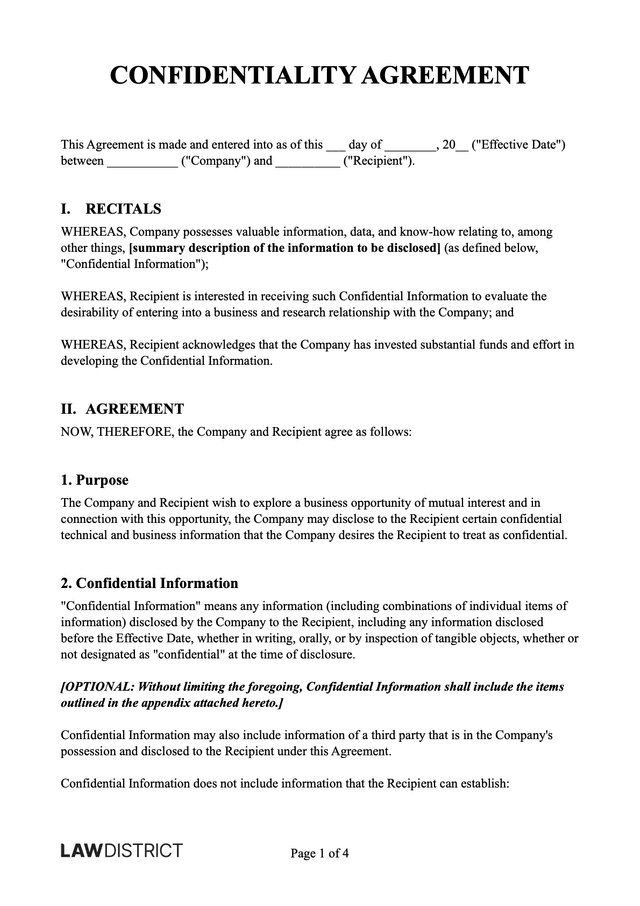
Confidentiality Agreement sample
Before drafting your Confidentiality Agreement, it’s helpful to review an example to understand how the document should be structured and what information needs to be included. Have a look at our sample Confidentiality Agreement template below:
Types of Confidentiality Agreement
There are different types of Confidentiality Agreements, each tailored to specific situations and relationships between the parties involved. Choosing the right type of agreement depends on whether one or both parties are sharing sensitive information.
The two main types are Mutual Confidentiality Agreements and Unilateral Confidentiality Agreements:
Mutual Confidentiality Agreement
A Mutual Confidentiality Agreement (also known as a two-way NDA) is used when both parties are sharing confidential information with each other, requiring reciprocal protection.
This type of agreement is commonly used in scenarios where businesses are exploring potential partnerships, joint ventures, or mergers, and both sides are required to disclose sensitive business data, intellectual property, or financial details.
A Mutual Confidentiality Agreement guarantees that neither party misuses nor discloses the other’s information during or after the agreement period.
This type of agreement is beneficial for collaborative projects, fostering trust by providing equal legal protection to both parties.
It’s essential that the terms clearly outline the obligations of both parties and the penalties for breach, ensuring that both sides are equally bound to confidentiality.
Unilateral Confidentiality Agreement
A Unilateral Confidentiality Agreement (or one-way NDA) is used when only one party is disclosing confidential information, and the receiving party agrees to protect that information from being disclosed or misused.
This is typically the case in situations where a company hires a contractor or an employee and needs to share proprietary data, business strategies, or product development details.
For example, when a company outsources part of its operations to a third-party vendor, the Unilateral Confidentiality Agreement ensures that the vendor does not share sensitive information with competitors or use it beyond the scope of the project.
Similarly, employers often require employees to sign Unilateral Confidentiality Agreements to prevent them from leaking proprietary information or trade secrets.
The agreement outlines the duties of the receiving party, such as limiting access to the information and preventing its disclosure to third parties.
The terms of the agreement will also specify how long the receiving party is bound to these obligations, guaranteeing the company’s interests are safeguarded even after the contractual relationship ends.
Confidentiality Agreement FAQs
Below are answers to some of the most commonly asked questions about Confidentiality Agreements. If you still have any doubts, feel free to consult legal professionals for more guidance.
Breaking a Confidentiality Agreement can lead to serious legal consequences. If you breach the agreement, the disclosing party can seek remedies, including financial damages or an injunction to prevent further misuse of the information. If you breach the agreement, the disclosing party can seek remedies, including financial damages, an account of profits or an injunction to prevent further misuse of the information.
In the UK, courts take breaches of Confidentiality Agreements seriously, and penalties can include compensation for losses or reputational damage.
A Confidentiality Agreement can last for a specified period, typically ranging from one to five years, or for an indefinite duration if necessary. The length of time the agreement remains in effect will depend on the nature of the information being protected.
Trade secrets, for example, may require indefinite protection, whereas other information may only need protection during the term of a project or until the information becomes public knowledge.
A strong Confidentiality Agreement should include the following elements:
- Description of the confidential information: Clearly outline what information is considered confidential. This may include customer lists, pricing strategies, business model, financial plans, product formula, trade secrets and employee information.
- Purpose of disclosure: Define why the information is being shared and for what purposes it can be used.
- Exclusions: You can exclude certain information from the scope of the confidentiality obligation. This includes information that is made public or information lawfully acquired from a third party.
- Permitted disclosures: You can permit the disclosure of confidential information for compliance with law and court orders.
- Duration: Specify how long the agreement will be in effect.
- Obligations of the receiving party: Outline the measures the receiving party must take to protect the information. The agreement may require the receiving party to implement appropriate organisational, technical, and contractual measures to maintain ongoing confidentiality. Additionally, it may require the receiving party to ensure its employees are bound by the same confidentiality obligations.
- Non-solicitation: If you disclose customer lists, lead lists, or employee information to an employee, contractor or a freelancer, you should prohibit them from engaging with your customers or employees.
- Return or destruction of confidential information: You should require the recipient to return and permanently delete all copies of confidential information.
- Intellectual Property clause: You must include a clause that states that disclosure of confidential information does not give the receiving party any rights, title or interests in the disclosed information.
- Consequences of breach: Detail the legal remedies available if the agreement is violated. It is advisable to include a liquidated damages clause if it would be hard to ascertain the amount of damages for breach of confidentiality.
- Assignment: Ensure that the confidentiality agreement cannot be assigned to a third party without your prior written consent.
- Governing law: You should specify the applicable law and jurisdiction where legal proceedings for breach of the confidentiality agreement can be started.
By including these key points, you can ensure that your Confidentiality Agreement is comprehensive and legally enforceable.
Try Lawdistrict Now
Instant and complete access to our entire library of legal forms
Edit, download and print in PDF from any device
Save time and money on legal document creation