
Partnership Agreement Template UK
A Partnership Agreement helps business partners define tailored rules on how they will operate their partnership. It outlines ownership structure and describes matters such as duties of each partner, profit and loss sharing, and what happens if a dispute arises or the partnership dissolves.

Fill forms in a few steps
Save, print & download
Done in 5 minutes
What is a Partnership Agreement?
A Partnership Agreement is a legal contract between two or more individuals who agree to run a business together for profit.
This legal document allows partners to define custom terms. It can set out what capital or assets each partner will provide, how the partners will share the profits, how the decision-making process will work, and how to handle exits or disputes.
A written contract helps avoid misunderstandings and strengthens the working relationship between the partners, especially in small businesses where roles often overlap.
Without one, your partnership will automatically be subject to the default rules under UK law. These may not reflect your intentions and could expose you to risk. A general Partnership Agreement gives you more control and legal clarity.
In the UK, partnerships are governed by the Partnership Act 1890. While this law outlines basic rules, it does not suit every business, and some of its default rules do not reflect commercial reality.
For instance, the default rule under the Law is that each partner is entitled to an equal share of the profits and capital of the business. However, partners rarely make equal capital contributions in practice. That’s why most partners create their own written agreement tailored to their needs.
Who needs a Partnership Agreement?
Any group of individuals or entities starting a business together should consider using a business Partnership Agreement template. This includes:
- Friends launching a small business
- Professionals forming a joint venture
- Family members running a shop or service
- Companies entering a business partnership contract
It’s especially useful for small business partnerships where roles and investments vary. You can protect everyone’s interests by setting expectations early.
Partnership Agreement sample for UK businesses
Before you start drafting, it’s helpful to review a simple business Partnership Agreement sample. A sample can show you how to structure your terms, what language to use, and what clauses are typically included.
You can also download our free Partnership Agreement template to help you make sure you do not miss any key details.
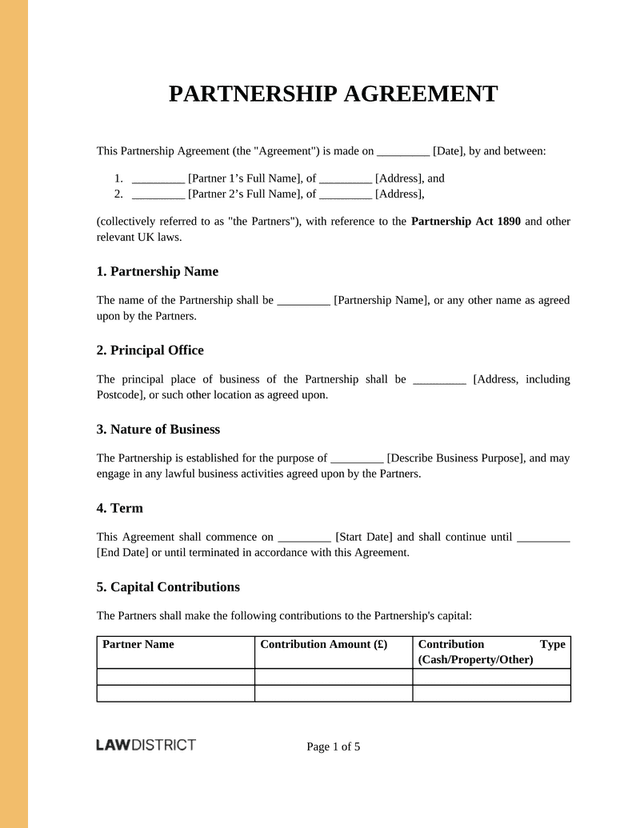
How to write a Partnership Agreement
Here’s what to include in a Partnership Agreement for businesses:
Partnership name
Choose a name for your partnership. It can be the partners’ surnames or a trading name.
Principal office
List the address where the business will operate.
Nature of business
Briefly describe what your partnership will do. This helps define the scope of activity.
Term of the agreement
State when the partnership starts and whether it has a fixed end date or continues until dissolved.
Capital contributions
Explain what each partner is contributing (cash, equipment, services, know-how, intellectual property rights) and clarify whether their contributions are capital investments or loans. The value of each input should also be stated.
Profit and loss sharing
Outline how profits and losses will be divided. It can be equal or in proportion to ownership interests. Describe the timing and method of profit distributions.
Partnership accounts and banking
Specify where the bank account will be held, who may access and use it, and how records are kept.
Management and decision-making
Define how decisions are made. Will each partner have equal say, or are roles split by responsibility? Additionally, you should clarify whether decisions can be made by a simple majority or if a qualified majority is required for important matters.
Partner duties and obligations
You should define the obligations and duties of each partner. For instance, while one partner may be responsible for sales, another partner can handle finance and accounting matters.
In addition, make sure to include clear requirements for time commitment and effort that each partner must make.
Drawings and remuneration
Set out whether partners can take regular payments or must wait for profits to be distributed.
Liabilities and indemnities
Clarify each partner’s responsibility for debts. Under the default rules of the Partnerships Act of 1890, partners are jointly and severally liable.
Dissolution and exit strategy
Explain when and how the partnership can be dissolved, or what happens when a partner leaves or they are expelled from the partnership. Furthermore, you should cover buyouts and succession plans.
Restrictions on competition
You may want to restrict partners from setting up competing businesses during or after the partnership. You should include a restrictive covenant clause in the partnership agreement to prevent a departing partner from competing with the partnership.
Restrictions on non-solicitation
Depending on the nature of your partnership, you may want to prevent a departing partner from soliciting your clients. Including a non-solicitation clause can help protect the partnership and reduce the risk of losing clients.
Dispute resolution
Set a method for handling disagreements, such as mediation, arbitration, or court action. Make sure to include a tie-breaker mechanism in case a vote ends in a tie.
Governing law
You should set out the applicable law (e.g. laws of England and Wales), and also the jurisdiction that will handle the disputes.
Amendments and notices
Detail how changes to the agreement must be made and how notices should be delivered.
Signatures and witnesses
All partners must sign and date the agreement, ideally with a witness present.
Including these clauses helps guarantee that your business partnership contract is clear, thorough, and legally useful.
Related Business Documents:
FAQs about Partnership Agreements
Yes. A Partnership Agreement signed by all parties is a binding legal document. As long as the terms are lawful and clear, courts will generally uphold the agreement. It can override default rules in the Partnership Act 1890.
No. For Partnership Agreements, UK law does not specify that they should be notarised. However, it must be signed by all partners. Having a witness can help prove its authenticity if challenged.
Yes. A legal entity, such as a limited company, can enter a business Partnership Agreement with individuals or other companies. The rights and duties of the company as a partner should be clearly stated in the contract.
Yes. A partner can leave if the agreement allows it. Most Partnership Agreement templates include exit clauses, such as buyout procedures or transfer of interest. If the partnership is dissolved, the agreement also covers how assets and liabilities are shared.
Try Lawdistrict Now
Instant and complete access to our entire library of legal forms
Edit, download and print in PDF from any device
Save time and money on legal document creation