
Free Power Of Attorney template UK
A Power Of Attorney is a legal document that lets you appoint someone you trust to act on your behalf. It allows you to make sure your affairs are managed if you are unable to handle them yourself.

Fill forms in a few steps
Save, print & download
Done in 5 minutes
What is a Power Of Attorney?
A Power Of Attorney (PoA) is a legal document that allows one person (the donor) to authorise another (the attorney) to make decisions on their behalf.
This could involve:
- Day-to-day money management
- Dealing with property
- Making arrangements for care and wellbeing
A Power Of Attorney is useful if you are abroad, unwell, or want someone you trust to manage your finances. It gives them clear legal authority to act for you.
In the United Kingdom, there are different types of Power Of Attorney, each with its own scope and rules.
Some are temporary, used while the donor retains capacity, while others continue if the donor becomes unable to make decisions.
A Power Of Attorney serves to protect both parties. It provides clear authority for the attorney to act, and helps guarantee that the donor’s wishes are respected.
Types of Power Of Attorney in UK
Understanding the types of Power Of Attorney UK law recognises is key to choosing the right one for your needs.
General Power Of Attorney
A general Power Of Attorney (sometimes called an ordinary Power Of Attorney) allows someone to act for you while you still have mental capacity. (Powers of Attorney Act 1971).
It is often used for short-term situations, such as if you are abroad for several months and need help with financial transactions. This type ends if you lose capacity.
Lasting Power Of Attorney
A lasting Power Of Attorney (LPA) continues even if you lose capacity. (Mental Capacity Act 2005) In England and Wales, there are two kinds:
- Lasting Power Of Attorney for property and financial affairs
- Lasting Power Of Attorney for health and welfare decisions
You must register this document with the Office of the Public Guardian for it to be valid.
When setting up a Lasting Power Of Attorney, the rules around signing and witnessing are stricter. Alongside independent witnesses, the document must also be signed by a certificate provider.
This is someone who confirms you understand what you’re doing and are not under pressure to create the LPA.
Enduring Power Of Attorney
An enduring Power Of Attorney (EPA) applied only to financial decisions. These were replaced by LPAs in 2007, but an EPA created before that date can still be valid if it was properly made.
Power Of Attorney sample - PDF & Word
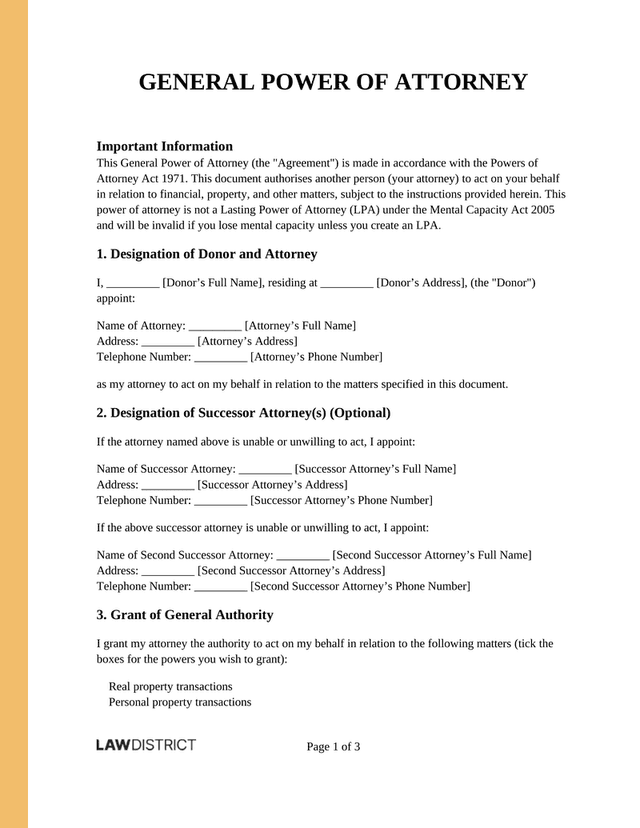
Before you create your own Power Of Attorney, it is helpful to look at a Power Of Attorney sample. Reviewing an example shows you how the document is structured, the clauses usually included, and the kind of wording that makes it legally sound.
How to get a Power Of Attorney: step by step
Our free Power Of Attorney template is designed to guide you through the process. When filling out a general Power Of Attorney form, these are the key sections you should expect:
- Designation of donor and attorney: Identify yourself as the donor and set out the details of your chosen attorney, including their address and contact details.
- Successor attorneys: Optional, but you may appoint backups if your first choice cannot act.
- Grant of authority: Decide what your attorney can do, such as handling property, banking, investments, tax affairs, or pensions.
- Specific authority: Add extra permissions if needed, such as selling property, managing rentals, or signing documents.
- Restrictions and instructions: Set out any limits on your attorney’s powers or specific directions you want followed.
- Effective date and duration: State when the agreement starts and whether it ends on a certain date or event.
- Revocation: Confirm your right to cancel the document at any time, provided you still have capacity.
- Governing law: Note the legal jurisdiction (England, Wales, Scotland, or Northern Ireland).
- Signatures and witnessing: Both donor and attorney must sign, with an independent witness also signing.
- Acceptance by attorney: The attorney confirms their willingness to act within the scope granted.
You can use our template as a strong foundation for your own document. Consider having a legal professional review the finished Power Of Attorney to make sure that it’s legally valid in your jurisdiction.
I have Power Of Attorney Form, now what?
Once the document is signed and witnessed, your attorney can begin acting under the authority granted. For LPAs in England, Wales, you must register them before use.
If you have set up a general Power Of Attorney, your attorney may use it straight away for everyday matters like:
- Managing bills
- Dealing with the bank
- Handling property
Remember that you can revoke the document at any time by written notice.
Power Of Attorney UK FAQs
The cost of Power Of Attorney UK depends on the type. Registering an LPA with the Office of the Public Guardian currently costs £82 per document. Using a solicitor may add fees, though you can use our free template if you prefer to prepare your own.
In Scotland and Northern Ireland, Powers Of Attorney work in a very similar way to those in England and Wales. The main difference is simply which body you register with. The purpose and effect of the Power Of Attorney remain the same.
In Scotland, Lasting Power Of Attorney documents are created under the Adults with Incapacity (Scotland) Act 2000. In Northern Ireland, they fall under the Mental Capacity Act (Northern Ireland) 2016.
In the UK, anyone over 18 who is not the appointed attorney or a close relative can act as a witness. The witness should be impartial and must be present when the donor signs the document.
Courts can override a Power Of Attorney if it is misused. They may decide to do this if the attorney is acting outside the authority granted, or if the donor did not have capacity when it was created. Complaints may be made to the Office of the Public Guardian.
Yes. A Power Of Attorney document becomes invalid once the donor dies. After death, responsibility for managing the estate passes to the executor named in the will. This is why you may see comparisons of Power Of Attorney vs executor of will.
For a general Power Of Attorney, you should give a certified copy to the bank so they can recognise the attorney’s authority. For LPAs, registration with the public authority is required before banks will accept them.
Try Lawdistrict Now
Instant and complete access to our entire library of legal forms
Edit, download and print in PDF from any device
Save time and money on legal document creation