
UK Indemnity Agreement template
An Indemnity Agreement sets out who is responsible for losses, claims, or expenses in a contract. This contract can be used to clarify indemnity terms and avoid disputes.

Fill forms in a few steps
Save, print & download
Done in 5 minutes
What is an Indemnity Agreement?
Indemnity Agreements are used to protect a party in a contract from financial loss caused by the actions of another party. It outlines who will pay for costs, damages, or legal claims if there is an issue.
In the United Kingdom, these are commonly used for business services, events, construction work, and high-risk activities.
Hold-harmless agreement vs Indemnity Agreement
While these types of contracts are similar and sometimes mentioned interchangeably, they do not always offer identical legal protection.
Review the differences between a hold-harmless and Indemnity Agreement below.
| Element | Hold-harmless agreement | Indemnity agreement |
|---|---|---|
| Main purpose | Protects a party from liability or claims. | Compensates a party for financial losses or damages. |
| Common use | Events, activities, and situations involving physical risk. | Business, construction, service, and commercial contracts. |
| Legal effect | May stop one party from being held responsible for a claim. | Requires one party to cover costs, losses, or legal expenses. |
| Use in the UK | Sometimes used interchangeably with indemnity. | Often used for more detailed financial protection clauses. |
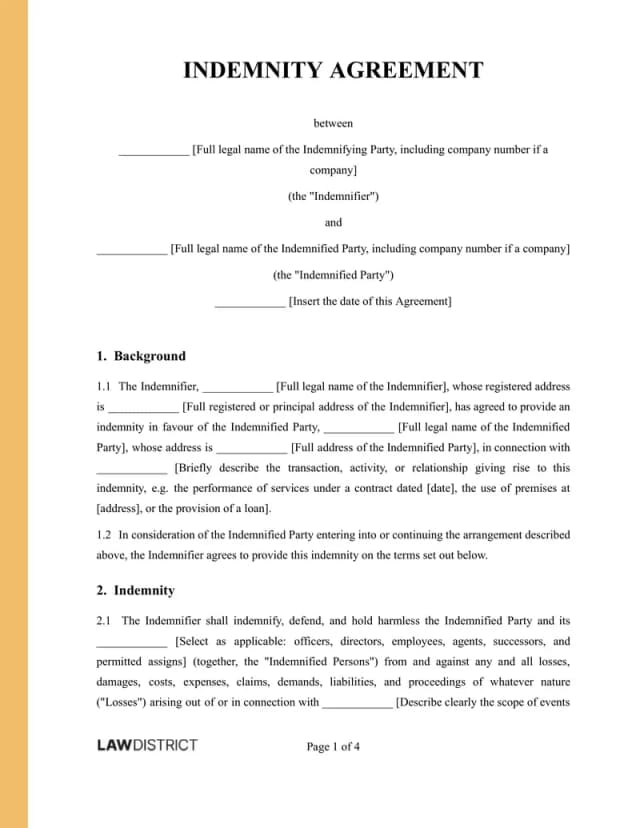
Indemnity Agreement free sample: PDF & Word
Review the following example Indemnity Form template to understand how your agreement should be structured and what it should include.
How to write an Indemnity Agreement
To create an Indemnity Agreement form, simply follow the steps below.
- Identify the parties: Include the full names and contact details of the indemnifier and indemnitee.
- Describe the activity or service: Explain the work, event, transaction, or situation the agreement covers.
- Define the indemnity: State which claims, losses, damages, expenses, or legal costs are covered by the agreement.
- Set limits and exclusions: Specify when protection does not apply, such as fraud or unlawful conduct.
- Add claim notice rules: Explain how and when the indemnitee must notify the indemnifier of a claim.
- Include payment terms: Specify when payments must be made after a valid notice of indemnity.
- Sign the agreement
- Both parties should review, date, and sign the document.
Use Lawdistrict’s Indemnity Agreement template as a helpful resource to quickly create your document, which you can have verified by a legal professional before signing.
Indemnity Agreement FAQs
If you still have doubts about using Indemnity Forms and clauses, the following answers to common questions can help you understand how to use this document.
To put your agreement into effect, you will need to sign it. However, only sign it when you understand the risks you are accepting. It’s a good idea to read the terms carefully, and if you do not understand anything, have the document reviewed by a professional.
A guarantee is usually a secondary promise to pay if another party fails to meet their obligation. An indemnity creates a primary obligation, meaning the indemnifier may be directly responsible for covered losses, even without first proving another party’s default.
A Data Protection Indemnity clause makes one party responsible for losses, fines, claims, or costs linked to data protection failures. It is often used where personal data is processed, shared, or transferred, helping allocate risk for breaches of UK GDPR or data handling obligations.
An indemnity letter is usually a written commitment from one party to cover specific losses or risks that is shorter than a full agreement. An Indemnity Agreement is typically a fuller contract, signed by both parties, with detailed terms on scope, notice, exclusions, payment, and governing law.
Try Lawdistrict Now
Instant and complete access to our entire library of legal forms
Edit, download and print in PDF from any device
Save time and money on legal document creation