
UK Limited Liability Partnership Agreement template
A Limited Liability Partnership Agreement sets out how an LLP is run in the UK. It defines each member’s role, profit share, decision-making rights, and responsibilities.

Fill forms in a few steps
Save, print & download
Done in 5 minutes
What is a Limited Liability Partnership?
A Limited Liability Partnership, or LLP, is a common business structure. It combines features of a traditional partnership with limited liability protection.
In the UK, an LLP can be set up by two or more members. A member can be an individual or a company, also known as a corporate member.
A UK Limited Liability Partnership has its own legal identity. This means it’s separate from its members.
Members are generally not personally responsible for business debts the LLP cannot pay. However, they are responsible for paying tax on their share of the profits.
The LLP must be registered with Companies House before it legally exists.
What does a Limited Liability Partnership Agreement contain?
A Limited Liability Partnership Agreement is a legal document that explains how the LLP will work in practice. It can cover:
- Capital contributions
- Profit sharing
- Voting rights
- Management duties
- Member exits
- Confidentiality
- Intellectual property
- Dispute resolution
UK LLPs have default legal rules. These rules may apply if the members do not agree on something.
For example, the default rules can affect:
- Profit sharing
- Management rights
- How new members are admitted
Advantages and disadvantages of Limited Liability Partnerships
An LLP can be a useful structure for professionals, consultants, agencies, and other businesses run by several members. However, it also comes with filing duties and formal responsibilities.
Below are some of the advantages and disadvantages of choosing this structure for your business.
| Advantages | Disadvantages |
|---|---|
| Members have limited liability for most business debts. | The LLP must be registered with Companies House. |
| The LLP has a separate legal identity. | Annual accounts and confirmation statements must be filed. |
| Members can agree to flexible profit-sharing rules. | Some LLP information appears on the public register. |
| Suitable for businesses with 2 or more members. | It may be more complex than a simple partnership. |
| The agreement can set clear management rules. | Poorly drafted agreements can cause disputes. |
Differences between Limited Partnership and Limited Liability Partnership
A Limited Partnership and a Limited Liability Partnership are not the same. The names are similar, but the legal structure and member responsibilities are different. The table below lays out some of the main differences.
| Limited Partnership | Limited Liability Partnership |
|---|---|
| Has general partners and limited partners. | Has members rather than partners. |
| General partners usually manage the business. | Members can manage the LLP unless agreed otherwise. |
| Limited partners cannot usually take part in management. | Members usually have management rights. |
| Liability depends on partner type. | Members generally benefit from limited liability. |
| A different legal structure from an LLP. | Registered as an LLP with Companies House. |
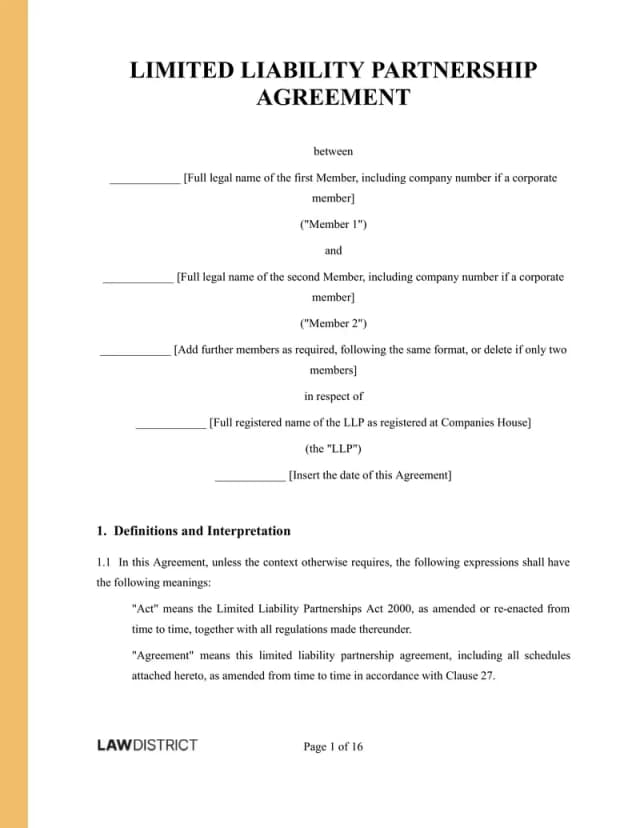
Limited Liability Partnership (LLP) example
Before you begin drafting your own LLP Agreement, it’s a good idea to take a look at an example to see the main clauses and structure. You can use the sample below as a guide.
What key clauses should an LLP Agreement include?
A Limited Liability Partnership Agreement should include clear rules for how the LLP will be managed. These clauses help members avoid confusion and reduce the risk of disputes.
| Clause | Why it matters |
|---|---|
| Member roles | Explains what each member is expected to do in the business. |
| Designated members | Confirms who is responsible for Companies House filings and legal duties. |
| Capital contributions | Records what each member puts into the LLP, such as money, assets, or services. |
| Profit and loss sharing | Sets out how profits and losses are divided between members. |
| Drawings policy | Explains when members can take money from the LLP before final profits are confirmed. |
| Voting rights | Shows how decisions are made and whether votes are equal or weighted. |
| Reserved matters | Lists major decisions that need unanimous or special approval. |
| Member exits | Explains what happens if a member retires, resigns, or is removed. |
| Good leaver and bad leaver rules | Helps decide how a leaving member’s share is valued. |
| Restrictive covenants | Limits what a leaving member can do with clients, staff, or confidential information. |
| Dispute resolution | Sets out how disagreements should be handled before going to court. |
If you want to make a comprehensive LLP in just a few minutes, consider using our customisable template. Just enter your partnership’s details and you’ll receive the finished document instantly.
Setting up and registration of an LLP
To register a Limited Liability Partnership in the UK, you must follow Companies House requirements. The LLP must have at least 2 members and at least 2 designated members.
1. Choose an LLP name
Choose a name that follows Companies House rules. The name must usually end with “Limited Liability Partnership” or “LLP”. It cannot be the same as an existing registered name.
2. Decide who the members will be
An LLP must have at least two members. These members can be people or corporate members.
The members should agree on their roles before registration. This includes who will manage the business, contribute capital, share profits, and act as designated members.
3. Appoint designated members
Designated members have extra legal responsibilities. These can include filing accounts, submitting confirmation statements, and making sure Companies House records are kept up to date.
An LLP must have at least two designated members.
4. Prepare your LLP Agreement
The LLP Agreement should explain how the business will be run. You do not usually file it with Companies House, but it’s one of the most important internal documents for the LLP.
You can use our template to make this document in just a few minutes.
5. Register the LLP with Companies House
You can register an LLP with Companies House using form LL IN01 or the online incorporation service.
The registration includes details such as the LLP name, registered office, and members.
6. Keep LLP records up to date
After registration, the LLP must keep its Companies House information current. You must report any changes in members to members or designated members within the required deadlines.
Limited Liability Partnership (LLP) FAQs
Here are the most frequently asked questions about Limited Liability Partnerships and LLP Agreements in the UK.
A general partnership does not usually have limited liability. In a standard partnership, partners can be personally responsible for the debts and obligations of the business.
An LLP is different. A registered Limited Liability Partnership has a separate legal identity, and its members are generally not personally liable for unpaid business debts.
This is one of the main reasons some businesses choose an LLP instead of a traditional partnership.
No. In the UK, a limited company and a Limited Liability Partnership are different business structures.
A limited company usually has shareholders and directors. An LLP has members and designated members.
Both structures can offer limited liability, but they are managed and taxed differently. An LLP is often used when the owners want a partnership-style structure with more flexible internal arrangements.
Yes, recent company law reforms have increased some compliance expectations for LLPs.
You may need to provide more accurate information to Companies House and keep your registered details up to date.
Your LLP should also have a lawful purpose. These changes make accurate registration and good record keeping more important.
Try Lawdistrict Now
Instant and complete access to our entire library of legal forms
Edit, download and print in PDF from any device
Save time and money on legal document creation