
UK Novation Agreement template
A Novation Agreement is used to replace one party in an existing contract with another. This document helps transfer contractual rights and obligations clearly, with the consent of all parties.

Fill forms in a few steps
Save, print & download
Done in 5 minutes
What is a Novation Agreement?
A Novation Agreement is a legal document used to replace one party in an existing contract with a new party.
This means the new party takes over the rights and obligations of the outgoing party.
It’s commonly used by:
- Businesses
- Contractors
- Lenders
- Borrowers
- Suppliers
- Service providers
A novation is usually a three-party agreement:
- The outgoing party
- The incoming party
- The remaining original party
All parties need to agree to the change. This is because one party cannot simply pass its contractual obligations to another person or business without consent.
Novation vs. assignment: key legal differences in the UK
Novation and assignment are both used to transfer contract interests, but they do not have the same legal effect.
| Point | Novation | Assignment |
|---|---|---|
| What it transfers | Rights and obligations under the contract. | Usually only contractual rights or benefits. |
| Consent needed | Consent of all parties is required. | Consent depends on the contract and type of assignment. |
| Effect on original party | The outgoing party may be released from future obligations. | The original party usually remains bound by obligations. |
| Contractual burden | Can transfer obligations if all parties agree. | Cannot normally transfer obligations by itself. |
| Common use | Replacing a party in a contract. | Transferring a right to payment or benefit. |
| Best for | Business sales, debt transfers, service changes, restructures. | Payment rights, receivables, or contract benefits. |
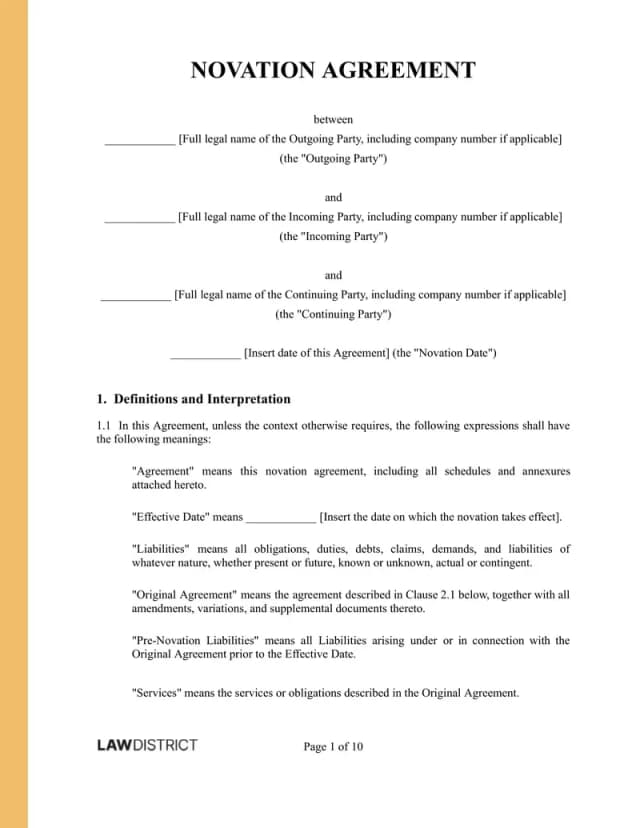
Novation Agreement example (PDF)
Before you begin drafting your own agreement, it can be helpful to look at an example. You can use the sampel Novation Agreement below as a guide:
Essential clauses to include in a UK Novation Agreement
A well-drafted Novation Agreement should make the transfer clear and reduce the risk of future disputes. Below are the essential clauses to include in your document:
| Clause | Explanation |
|---|---|
| Parties | Identifies the outgoing party, incoming party, and remaining party. |
| Original contract | Clearly describes the contract being novated, including its date and parties. |
| Consent to novation | Confirms that all parties agree to the replacement. |
| Effective date | States when the incoming party takes over the contract. |
| Transfer of rights | Explains which contractual rights pass to the incoming party. |
| Assumption of obligations | Confirms which duties the incoming party accepts. |
| Release of outgoing party | States whether the outgoing party is released from future or past obligations. |
| Past liabilities | Explains who is responsible for claims, breaches, or payments before the novation date. |
| Future liabilities | Confirms who is responsible after the novation takes effect. |
| Indemnities | Sets out who must compensate another party if specific losses arise. |
| Warranties | Confirms key facts, such as authority to sign and validity of the contract. |
| Notices | Updates where legal notices and formal communications should be sent. |
| Third-party rights | States whether non-parties can enforce terms of the agreement. |
| Governing law | Confirms which law applies, such as the law of England and Wales. |
| Signatures | Ensures the agreement is signed correctly by all required parties. |
Novating specific contract types: debt, construction, and services
Novation can be used for different types of contracts. The wording should match the contract being transferred and the risks involved.
Debt novation
A debt novation may be used:
- When a new debtor takes over repayment obligations
- When a debt arrangement is replaced with a new one involving different parties
The agreement should state how much is owed and any repayment terms. It should also confirm whether interest, security, guarantees, or previous defaults are affected.
Debt novation should be drafted carefully because it can change who is legally responsible for repayment.
Construction contract novation
Novation is common in construction and development projects. For example, a consultant’s appointment may be novated from an employer to a contractor after a design and build contractor is appointed.
The agreement should be clear about:
- Design responsibility
- Previous work
- Professional duties
- Insurance
- Warranties
- Liability for defects
Construction novations can involve significant risk, so the wording should be precise.
Services contract novation
A services contract may be novated when a supplier, contractor, or service provider is replaced.
The agreement should confirm:
- When the incoming provider takes over
- What services must continue
- Who is responsible for work already completed
This helps avoid disruption and protects both the client and provider.
Novation Agreements FAQs
If you still have some doubts, you can find the answers to some of the most frequently asked questions about Novation Agreements in the UK below.
A Novation Agreement is required when one party to a contract needs to be replaced by another, and both rights and obligations must transfer.
It is often used when a business is sold, a contract is moved to another company, a supplier is replaced, or a new debtor takes over repayment duties. All parties should agree to the novation because contractual obligations cannot normally be transferred without consent.
Yes, a Novation Agreement can be legally binding if it’s properly agreed and executed by the parties.
Consideration is usually required unless the novation is made by deed. If the document is signed as a deed, UK execution rules should be followed, especially for companies.
Try Lawdistrict Now
Instant and complete access to our entire library of legal forms
Edit, download and print in PDF from any device
Save time and money on legal document creation