
Tenancy Agreement template for UK rentals
A tenancy agreement is a written legal document that sets out the terms of a rental arrangement between a landlord and a tenant. It usually includes key details such as the rent, deposit, notice periods, and the rights and responsibilities of each party. This template is fully compliant with the Renters' Rights Act.

Trusted by 5,670 users.
The type of property being rented is a:
Fill forms in a few steps
Save, print & download
Done in 5 minutes
What is a Tenancy Agreement?
A Tenancy Agreement is a legally binding contract between a landlord and tenant, outlining the terms under which the tenant can occupy the property.
This type of agreement details the rights and responsibilities of both parties, covering aspects such as:
- Rent and rent increases
- Deposit
- Duration of tenancy
- Responsibility for repairs, maintenance, and insurance
- Right to sublet
Tenancy agreements can be written or oral, though written agreements provide more security and clarity for both you and your future tenants.
Create a UK Tenancy Agreement that follows housing laws in your area with our easy-to-follow template.
Tenancy Agreement updates under the Renters’ Rights Act 2026
The Renters’ Rights Act introduces new responsibilities for landlords, and major changes to how tenancies work in England.
Important deadline for existing landlords
If you have an existing tenancy that started before 1 May 2026, you must provide your tenant with the government's official Renters' Rights Act Information Sheet by 31 May 2026. Failure to do so can result in a fine of up to £7,000.
The Information Sheet must be downloaded from the official GOV.UK website and provided to every named tenant either digitally or as a printed copy. It cannot be altered.
Important changes to how tenancies work in England
The Renters’ Rights Act 2025 introduces significant changes to how tenancy agreements work in England. It replaces the previous Section 21 system with new rules that strengthen tenant protections and change how tenancies are:
- Structured
- Managed
- Ended
From 1 May 2026, new tenants in England should receive a written statement of terms before agreeing to the tenancy. This must include key details such as the rent and the landlord’s name and address.
What replaces Assured Shorthold Tenancy Agreements?
Before 1 May 2026, most private renters in England had an assured shorthold tenancy (AST).
From 1 May 2026, most of these tenancies move to the new assured tenancy system, Assured Periodic Tenancy. Under the Renters’ Rights Act 2025:
- Fixed-term ASTs are no longer the standard
- Most tenancies are now periodic (rolling) agreements by default
- Section 21 “no-fault” evictions have been abolished
This means:
- Tenancies no longer end automatically after a fixed term
- Tenants can stay indefinitely unless valid legal grounds apply
- Landlords must follow stricter legal procedures to regain possession
You may still see ASTs referenced, but they now apply mainly to legacy agreements signed before the law change, the new official name will be Assured Periodic Tenancy.
Difference between a lease and Residential Tenancy Agreement in the UK
The terms “Lease” and “Tenancy Agreement” are sometimes used interchangeably, however, they usually refer to different types of letting arrangements.
While the term “Tenancy Agreement” typically refers to residential letting, “lease” is usually used in reference to long-term arrangements and for the lease of commercial property.
The table below explains the key distinction between a Lease and a Tenancy Agreement form.
| Tenancy Agreement | Lease | |
|---|---|---|
| Duration | Typically periodic (rolling) | Usually long-term (over 3 years). |
| Termination | Tenant can leave with notice; landlord needs legal grounds. | Fixed term. Early termination can be complex and is often subject to strict conditions. |
| Use | Used for residential properties. | Used for both residential and commercial properties. |
| Legal formality | Usually a written agreement, could also be entered into verbally if it is for less than 3 years. | If a lease is more than three years, it must be signed as a deed, and this deed must satisfy specific requirements. |
| Flexibility | More flexible. Terms can be changed with the mutual agreement of the parties without formalities. | Less flexible. Formalities to change the lease via deed of variation must be followed. |
| Registration | Not required to be registered. | Leases extending a certain term (usually over 7 years) must be registered at the Land Registry. |
Tenancy Agreement Sample
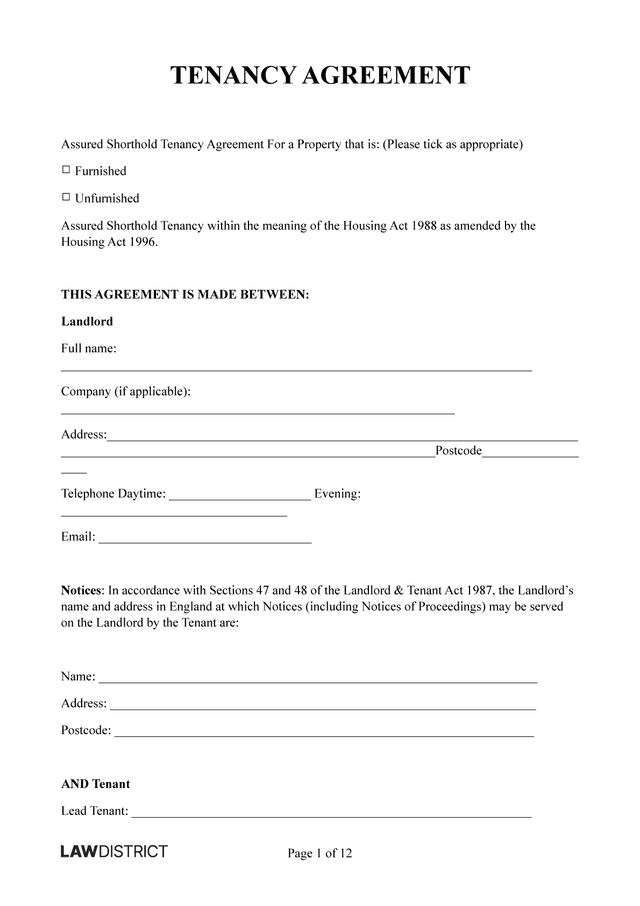
Creating a Tenancy Agreement in the United Kingdom can feel overwhelming without a clear starting point. Our sample Tenancy Agreement offers a structured template, guiding you through essential components.
Use this example of a simple Tenancy Agreement for the UK to craft a comprehensive form tailored to your specific needs.
When you should use a Tenancy Agreement
In the UK, a Tenancy Agreement is crucial in various scenarios. Here are some examples of when you may need one:
- Renting out property: Essential for property owners wanting to rent out their property.
- Renting a place to live: Crucial for individuals or families looking for a rental home.
- Subletting: Necessary when a tenant wishes to rent out part or all of their leased property to another individual.
- Short-term rentals: Important for short-term stays beyond typical holiday durations.
Using this document correctly is even more important from 2026, as Tenancy Agreements must reflect the new periodic tenancy system and updated legal rules on ending a tenancy.
Types of properties that need Tenancy Agreements
Tenancy Agreement forms apply to a variety of property types in the United Kingdom. For residential purposes, you can create a contract if you plan to rent out a:
- Flats
- Houses
- Shared accommodations (e.g., single rooms)
However, you can also use a commercial lease if you plan to rent out one of the following to a business:
- Office
- Retail space
- Warehouse
- Industrial unit
Make sure you understand what agreement you should use and what to include in your document to correctly make a Tenancy Agreement.
Do I need to pay fees on a Tenancy Agreement
Following the Tenant Fees Act, most letting fees paid by tenants in the private rented sector have been banned.
Only permitted payments as defined under the Tenant Fees Act 2019 may be charged. Some of the permitted charges are as follows:
- Late rent fees
- Lost keys or fobs
- Ending tenancy early
- Changing or transferring the tenancy
Terms to include in a Tenancy Agreement
When crafting a tenancy agreement, make sure to address key terms:
- Property address
- Names of all parties involved
- Rental amount and payment details
- Start date of the tenancy
- Tenant and landlord obligations
- Procedure for reporting and dealing with repairs and maintenance
- Insurance implications
- Deposit details and protection scheme information
- Conditions under which the deposit may be withheld
- Circumstances where Landlords may make deductions from the deposit
- Responsibility for bills, such as gas, water, internet, and electricity bills
- Responsibility for council tax
- Notice periods to end the tenancy agreement and formalities
Legal obligations for landlords before a tenancy starts
Before a new tenancy begins in England, landlords must provide tenants with the following:
- A valid Gas Safety Certificate issued by a Gas Safe registered engineer
- An Energy Performance Certificate (EPC) with a rating of E or above
- A copy of the government's How to Rent guide
- Evidence that smoke alarms are fitted on each floor and carbon monoxide alarms are fitted in rooms with a solid fuel appliance
Landlords must also carry out a Right to Rent check to confirm the tenant has the legal right to rent in England.
Failing to meet these obligations can affect your ability to regain possession of the property and may result in financial penalties.
How to write a Tenancy Agreement
Follow these steps to understand how to draw up a Tenancy Agreement.
Take advantage of our free Tenancy Agreement form for the UK, along with the following instructions to avoid issues during your tenancy.
- State the property type: Tick if the property is furnished or unfurnished.
- Identify the parties: Clearly state the full names, addresses, and contact information of the landlord(s) and tenant(s).
- Describe the property: Detail the address and type of property being rented, including specific rooms or amenities that are included or excluded.
- Outline the main terms: Specify the number of occupants, rent details, and any included services.
- Provide deposit information: State if there is a deposit and define the amount.
- Include confidentiality and data protection clauses: Include conditions that comply with GDPR (General Data Protection Regulation), detailing how the personal information of the tenants will be handled and protected.
- Attach documents: State if any other documents are attached to the agreement.
- Signatures: Ensure the agreement is signed by all parties involved. While not always required, having witnesses to the signing can add validity.
Why use Lawdistrict for your Tenancy Agreement
Use our free UK Tenancy Agreement template to create a bespoke written agreement that provides clarity and eliminates risks of disputes between landlord and tenant.
Our template can help you and your tenants stay protected and clear about your respective rights and obligations, and comply with applicable tenancy-related laws in the UK.
You can download our basic UK Tenancy Agreement PDF or Word document. However, for a more detailed contract, personalise your own with our online tool to add the important details that are specific to your agreement.
Once you have your contract, you can have it reviewed quickly by a legal professional to guarantee it’s ready to be put into effect.
Tenancy Agreement FAQs
Navigating the complexities of Tenancy Agreements can be challenging. Here, we address some frequently asked questions to help clarify important aspects of Tenancy Agreements in the UK.
A guarantor's obligations under a tenancy agreement typically last for the duration of the tenancy.
If the tenancy is extended or transitions into a periodic tenancy (rolling from month to month), the guarantor's responsibilities usually continue. However, the wording of the guarantee may provide otherwise.
Guarantors need to understand that they may be liable for unpaid rent or costs for damage beyond normal wear and tear for as long as the Tenancy Agreement is in effect.
From 1 May 2026, most private tenancies in England are periodic by default. This means that they do not automatically end after a fixed term.
A tenant can usually end the tenancy by giving 2 months’ notice, unless a shorter notice period was agreed in writing. In contrast, a landlord can only seek possession if they have a valid legal ground and follow the correct legal process.
Even without a written tenancy agreement, tenants in the UK are automatically protected under the law. You have the right to:
- Live in the property undisturbed
- Challenge excessively high charges
- Live in a safe property in a good state of repair
- Be protected against unfair rent and unfair eviction
- Have your deposit returned at the end of the tenancy (provided you meet the terms of your tenancy)
A verbal agreement can still be legally binding, but proving the terms of the agreement can be more challenging.
It's always best to have a written agreement to avoid misunderstandings and ensure that both parties are clear on their rights and responsibilities.
Yes, you can draft your own rental agreement in the United Kingdom, as long as it includes all legally required terms and clearly sets out the rights and responsibilities of both landlord and tenant.
Using our Landlord Agreement template, you can cover the key clauses and avoid common omissions. Once it’s complete, you can have a solicitor review the agreement to confirm that everything is correct and legally compliant.
Try Lawdistrict Now
Instant and complete access to our entire library of legal forms
Edit, download and print in PDF from any device
Save time and money on legal document creation