
Prenuptial Agreement UK template
A Prenuptial Agreement, also known as a ‘prenuptial contract’ or ‘prenup’, is a legal document signed by a couple before their marriage or civil partnership. The document specifies each person’s assets. It also sets out how these, along with any future assets, are intended to be divided if the relationship ends. Draft a prenuptial contract and record your mutual decisions in advance.

Fill forms in a few steps
Save, print & download
Done in 5 minutes
What is a Prenuptial Agreement?
A Prenuptial Agreement, also known as a ‘prenuptial contract’ or ‘prenup’, is a legal document signed by a couple before their marriage or civil partnership.
The document specifies each person’s assets. It also sets out how these, along with any future assets, are intended to be divided if the relationship ends.
You can draft a prenuptial contract to record your mutual decisions in advance. This clarifies financial arrangements and helps to prevent disputes.
What is included in a Prenuptial Agreement?
Prenuptial Agreements set out financial matters. This includes the financial rights and responsibilities of each person.
The agreement should be tailored to your individual circumstances and provide full disclosure of all assets and liabilities.
Prenuptial Agreement UK sample (PDF & Word)
Before you draft your own Prenuptial Agreement, it can be helpful to review an example. Use the template below as a guide for drawing up your document.
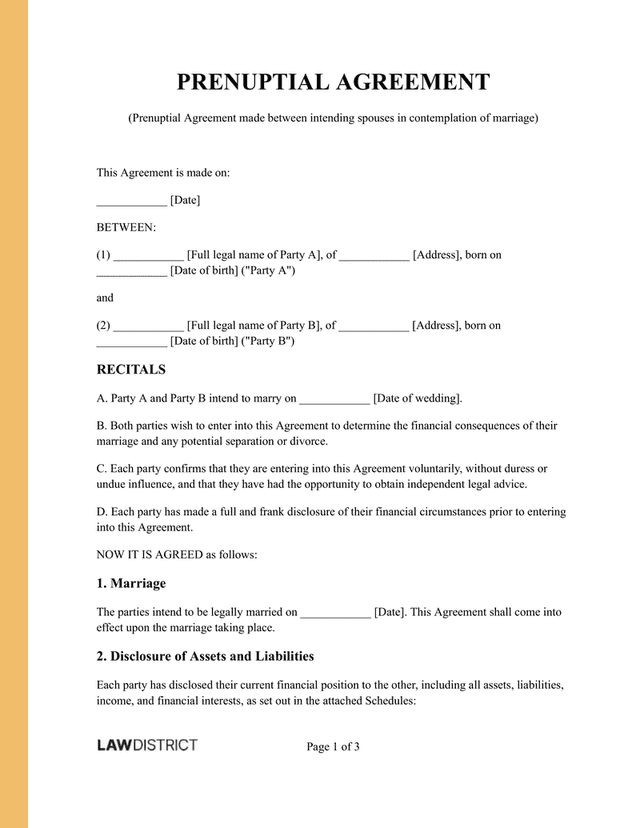
Prenuptial Agreement common clauses
Party details
Include the full legal names and home addresses of each person in the relationship. Provide the date of the upcoming marriage or civil partnership.
Disclosure of assets and liabilities
Provide a list of each person’s assets and liabilities, including:
- Property
- Savings and investments
- Pensions
- Business interests
- Inheritances
- Debts and loans
Confirm that the list is complete and accurate, and state that the Prenuptial Agreement is based on this disclosure.
Separate property
Identify the assets each person owns before the relationship and intends to retain as their own. Detail if any future increases in their value will also remain with the owner.
Matrimonial property
Define which assets are shared and the ownership of property acquired during the marriage or civil partnership. Indicate if shared assets are held jointly or proportionately, and set out how these would be divided.
Debt
Allocate responsibility for pre-marital and marital debts, and distinguish between personal and business liabilities. Set out any indemnities relating to the other person’s debts.
Spousal maintenance
Indicate if either party may claim spousal support. If so, outline the amount, duration, any limits, and the circumstances in which it may be varied.
Housing
Address the family home. Specify who retains it if the relationship ends, and if one person may reside there temporarily. Indicate how any sale proceeds and mortgage obligations will be managed.
Inheritance
Specify the treatment of inheritances and trusts before and during the relationship. Indicate if these assets, along with any gifts received, will remain the receiving party’s separate property or not.
After preparing your document, have a legal expert review your prenuptial contract to make sure it’s ready for signing.
Pros and cons of a Prenuptial Agreement
The table below provides an overview of the key advantages and disadvantages of a prenuptial contract:
| Pros | Cons |
|---|---|
| Clarifies how assets and liabilities are managed | Requires full and accurate financial disclosure from both parties |
| Records agreed-upon financial arrangements before your marriage or civil partnership | Must be signed at least 28 days in advance of your wedding or civil partnership |
| Protects assets owned before your marriage or civil partnership | Might need to be revised if your financial circumstances change significantly |
| Sets clear expectations if your relationship ends | The subject may be a sensitive matter to discuss before your marriage or civil partnership |
Prenuptial Agreement vs Cohabitation Agreement
If you’re not planning to marry or enter into a civil partnership, a Cohabitation Agreement may be suitable.
The table below outlines the main differences between a Prenuptial Agreement and a Cohabitation Agreement in the UK:
| Prenuptial Agreement | Cohabitation Agreement | |
|---|---|---|
| Who is it for | Couples planning to wed or register a civil partnership | Couples living together who are not married or in a civil partnership |
| When is it signed | Before your wedding or civil partnership | Before or during your period of cohabitation |
| Main purpose | Defines the financial arrangements for your marriage or civil partnership, and in the event that the relationship ends | Defines the financial and living arrangements between cohabitating partners who are not married or in a civil partnership |
UK Prenuptial Agreement FAQs
Below are answers to the most common questions about prenuptial contracts in the UK:
A Prenuptial Agreement is not automatically legally binding, but UK courts will give it serious consideration if:
- Both parties entered the agreement voluntarily.
- The terms of the agreement are considered fair.
- Both parties received independent legal advice.
- Each party provided a full and honest financial disclosure.
- The agreement was signed well in advance of your wedding or civil partnership.
No. A Prenuptial Agreement must be signed before your wedding to be valid. Couples who are already married or in a civil partnership have the option of entering into a Postnuptial Agreement instead.
No, but it’s strongly recommended that each party receives independent legal advice to increase the enforceability of the agreement. A solicitor can assist with reviewing the terms of the drafted prenuptial contract before it’s signed.
Try Lawdistrict Now
Instant and complete access to our entire library of legal forms
Edit, download and print in PDF from any device
Save time and money on legal document creation