
Free Website Terms and Conditions template
Create your Website Terms and Conditions to protect your online business from legal risks and establish rules for users.

Fill forms in a few steps
Save, print & download
Done in 5 minutes
What Are Online Terms and Conditions for a Website?
Website Terms and Conditions (T&Cs) are a set of rules that outline how visitors or customers can use your website.
This legal document serves as an agreement between you (the website owner) and anyone who visits or interacts with your site. It establishes guidelines for acceptable user behaviour, limits your liability, and protects your intellectual property.
By having Website Terms and Conditions in place, you create a clear understanding of the obligations between you and your website users. While not legally required in the UK, they offer protection if disputes arise.
Who needs Website Terms and Conditions?
Any business or individual operating a website in the UK should have Terms and Conditions. Whether you run a blog, e-commerce store, online service, or mobile app, having this document allows you to set the terms of how your website can be used.
For example, if you sell goods or services online, Website Terms and Conditions can cover critical areas such as:
- Payment terms
- Returns
- Refunds
- Limitations of your liability and disclaimer of warranties
If your website allows users to create accounts, you can outline their responsibilities and the rules they must follow.
Without a clear agreement in place, you leave yourself exposed to potential legal issues. Website Terms and Conditions allow you to manage users’ expectations, guaranteeing that your website is used in the manner you intend.
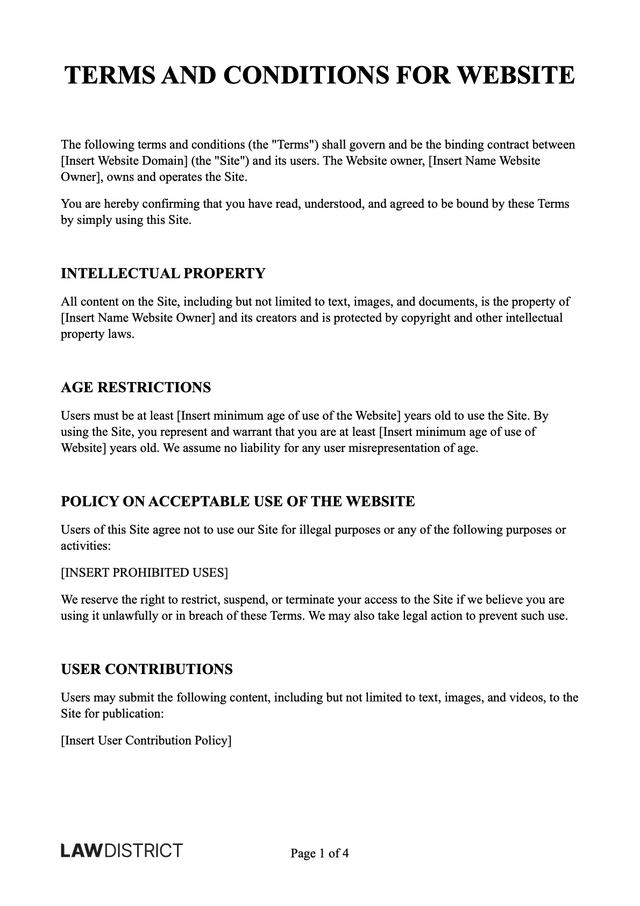
Sample Website Terms and Conditions template
Before drafting your Website Terms and Conditions, have a look at our sample template. This can help you understand the general structure and what clauses to include:
Reasons to have a Terms and Conditions
There are several important reasons why you should consider implementing Website Terms and Conditions:
Limit your liability
Website Terms and Conditions can help limit your liability in case of issues like user disputes, incorrect information, or website outages.
Protect intellectual property
Terms and Conditions allow you to protect your brand’s intellectual property, including your IP rights over your software, logos, content, and other creative works.
Set user guidelines
This document allows you to outline acceptable and unacceptable behaviours. This might include prohibiting spam, harassment, or illegal activities on your platform.
Resolve disputes
If conflicts arise, your Terms and Conditions can set out how disputes will be resolved, which can save you time and money by avoiding court proceedings.
Compliance with the law
For businesses that handle personal data, Terms and Conditions can help guarantee compliance with relevant regulations, such as the Consumer Rights Act 2015 or the Electronic Commerce Regulations 2002.
Clauses to include in Website Terms and Conditions
To guarantee your Website Terms and Conditions are effective, including specific key clauses is important. Here are some of the clauses typically included:
- Intellectual property: All patent rights, trademark and copyright over your software, website and content belong to you; copying or reproduction without permission should be prohibited.
- Age restrictions: Set a minimum age for access to your website and services, typically above 18 years of age.
- Description of Services: You should clearly define the scope of your products/services to avoid disputes with your customers.
- Disclaimer of Warranties: To the maximum extent that applicable law allows it, you should disclaim any warranty related to the suitability, availability, or quality of your products or services. This will limit your legal liability.
- Disclaimer of warranties for results: You should disclaim any warranty that your product or service will achieve any particular result or outcome.
- Disclaimer of Liability: If your product or service causes your customers or other third parties damages, you might face unlimited legal liability. Therefore, you must ensure that this clause lists specific types of damages you will not be liable for loss of profits, revenue and damages to third parties.
- Acceptable use: Define prohibited actions like spamming or offensive content.
- User contributions: Users must own their uploaded content, and you reserve the right to remove it.
- Account responsibilities: Users must safeguard their login details; misuse may result in termination.
- Sales and subscriptions: Clarify terms for product purchases, subscription renewals, and cancellations.
- Payments and shipping: State payment methods, delivery details, taxes and fees, and clarify if the price includes shipping fees or taxes.
- Cancellations and refunds: Outline policies on cancelling orders and refund processes.
- Consumer protection: Highlight user rights under UK law, like the 14-day cooling-off period.
- Additional terms and contact: Provide any specific policies and contact information.
By incorporating these clauses, you help protect your business while guaranteeing transparency and clarity for your users.
Website Terms and Conditions FAQs
Below, you’ll find answers to some of the most commonly asked questions about Website Terms and Conditions in the UK.
No, Website Terms and Conditions are not legally required in the UK. However, they are strongly recommended as they protect your business from legal risks and help set clear rules for user behaviour.
They also provide a layer of professionalism and transparency that can build trust with your website users.
Your Website Terms and Conditions should be easy for users to find. The most common place to display them is in the footer of your website, where they are accessible from any page.
Additionally, if your website requires users to create accounts, consider requiring users to agree to Terms and Conditions during the account registration process. You can implement this with a consent checkbox.
You should also require users to actively agree to your terms and conditions and make them easily accessible to users on any checkout or payment pages if you run an e-commerce site. This guarantees that users are fully informed before making purchases.
Lastly, if you have ‘Contact Us’ or ‘Submit a complaint’ sections on your website, you should also require users to agree to your terms and conditions when they submit a request to you or when they contact you.
Try Lawdistrict Now
Instant and complete access to our entire library of legal forms
Edit, download and print in PDF from any device
Save time and money on legal document creation