
Website Privacy Policy Template (UK)
A Website Privacy Policy outlines how your website collects, uses, and safeguards users' data. Learn why you need one, how to create it, and the legal obligations you must follow in the UK.

Fill forms in a few steps
Save, print & download
Done in 5 minutes
What is a Website Privacy Policy?
A Website Privacy Policy is a legal document that explains how personal data from website visitors is handled. Personal data can include names, email addresses, payment information, and IP addresses.
In the UK, websites that process personal data must comply with the UK General Data Protection Regulation (GDPR) and the Data Protection Act 2018.
Your Privacy Policy should clearly communicate:
- What kind of personal data you collect
- How you use the data (to improve products and services, to process payments, to display personalised ads, etc.)
- Whether it is shared with third parties such as advertising partners, analytics tools like Google Analytics or payment processors
- How long you store personal data
Having a Website Privacy Policy for your site guarantees transparency with your users and compliance with UK law.
Why do you need a Privacy Policy?
You need a Privacy Policy because it’s a legal requirement if your website collects personal data. Under the UK GDPR and UK data protection laws, you must provide clear information to users about how their personal data is handled.
Without this document, you expose your business to legal risks, including fines and penalties.
A Privacy Policy helps ensure that you’re meeting your legal obligations while maintaining trust with your visitors. Websites without a proper policy in place can face significant financial and reputational risks. It helps you:
- Avoid legal issues and penalties.
- Build credibility and trust with your users.
- Meet third-party service provider requirements (e.g., Google Analytics).
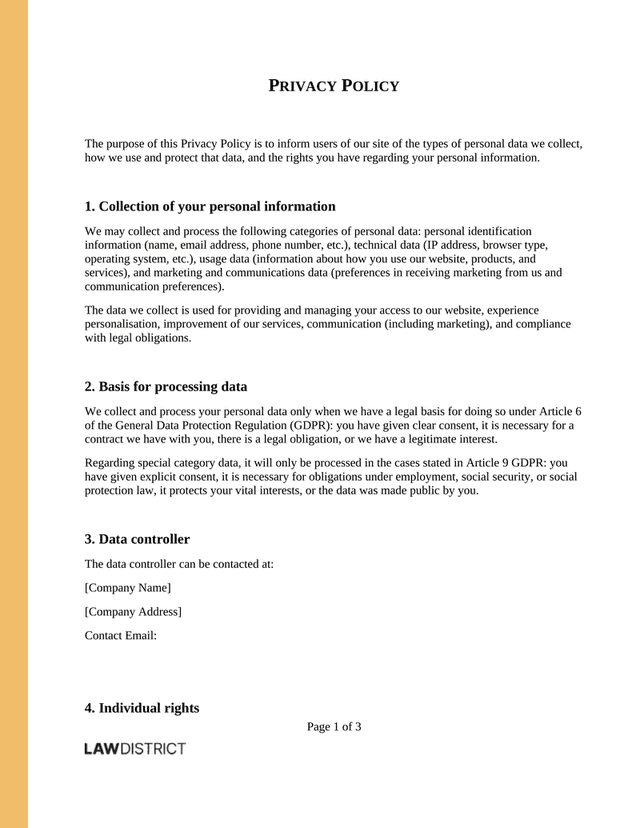
Sample Website Privacy Policy
Before drafting your privacy policy, it's a good idea to review a sample Website Privacy Policy template. Our sample below will give you a general idea of how to structure your own document.
How to write a Privacy Policy for your website
Follow these steps to write a privacy policy for your website that complies with UK laws:
1. Identify the data you collect
Start by listing all the types of personal data your website collects, such as names, email addresses, payment information, information about website visitors' browsing activities, device information, browser settings and IP addresses. Be transparent about both automatic and non-automatic data collection methods.
2. Explain why you collect and use data
Clearly outline the purposes of collecting and processing data for each data processing activity. You might collect data to complete transactions, improve user experience, or send marketing emails (with user consent).
3. Identify the lawful basis to collect and use personal data
Under the UK GDPR, data collection must have a lawful basis. You must justify the collection and use of personal data by relying on a lawful basis. Article 6 of the UK GDPR lists 6 lawful bases you can rely on, including ‘consent’, ‘contractual necessity’ and ‘legitimate interests’.
For instance, you must rely on a website visitor’s consent to collect personal data for personalised advertising and analytics purposes.
4. Explain how you might share data with third parties
Include details about third-party sharing and service providers you use. For instance, if you use cookies, trackers or web beacons on your website, you might be sharing visitor’s personal data with these third-party service providers. Furthermore, you might also be compelled to disclose personal data to comply with a court order or a government request.
5. Data retention period
You must explain how long you retain each category of personal data and what criteria you use to determine data retention periods.
6. Provide users with rights and choices
You must inform users of their rights under GDPR, such as the right to access, correct, or delete their data. Include instructions on how users can opt out of data collection or withdraw consent.
7. Explain users’ right to file a complaint
Your privacy policy must also explain that users have the right to file a complaint in relation to your handling of their personal data and how they can file an official complaint.
8. Update and maintain your privacy policy
Review and update your privacy policy regularly, especially when your business or data practices change. Keeping it current ensures ongoing compliance with UK data protection laws.
Following these steps will help you create a comprehensive website privacy policy that protects both your business and your users.
Privacy Policy FAQs
Below are answers to some of the most frequently asked questions about website privacy policies.
Yes, UK law mandates that any website collecting personal data must have a privacy policy. Under the GDPR and the Data Protection Act 2018, you must inform users about how their personal data is collected, processed, and shared.
Without a privacy policy, you may face legal consequences, including hefty fines, especially if your website processes significant amounts of user data. Failure to comply can also damage your reputation, as users may lose trust in your site’s handling of personal information.
Yes, it’s important to regularly update your privacy policy. You should review and revise your policy when there are changes to data protection laws or when your business adopts new data collection methods. Best practices suggest updating the policy annually.
However, significant changes such as a data breach, new technology, or the introduction of third-party services, should prompt immediate updates.
Keeping your policy up-to-date ensures that your users are informed of how their data is handled, and that your business remains compliant with the latest legal requirements.
Try Lawdistrict Now
Instant and complete access to our entire library of legal forms
Edit, download and print in PDF from any device
Save time and money on legal document creation