
Free Job Offer Letter Template
A Job Offer Letter is a formal document detailing a job offer, including the role, salary, benefits, start date, and terms. Acceptance forms the foundation of the employment relationship.

What position is offered?
Fill forms in a few steps
Save, print & download
Done in 5 minutes
What is a Job Offer Letter?
A Job Offer Letter, also known as an Employment Offer Letter or Formal Job Offer Letter, is a formal document issued by an employer to a candidate selected for a position.
It serves as the first official communication between the company and the prospective employee, outlining the key terms of employment such as job title, salary, start date, and any conditions that must be met before employment begins.
The letter confirms the offer and provides key information that helps the candidate make an informed decision about accepting or declining the role. It also sets expectations for both parties, ensuring transparency around employment terms.
A job offer letter is not a legally binding employment contract, however a well-written offer letter minimises legal risks, reflects the professionalism of the company and reinforces its commitment to the candidate.
Employers may also use this opportunity to highlight company values, benefits, and other perks to further encourage the candidate to join the organisation.
Sample Job Offer Letter
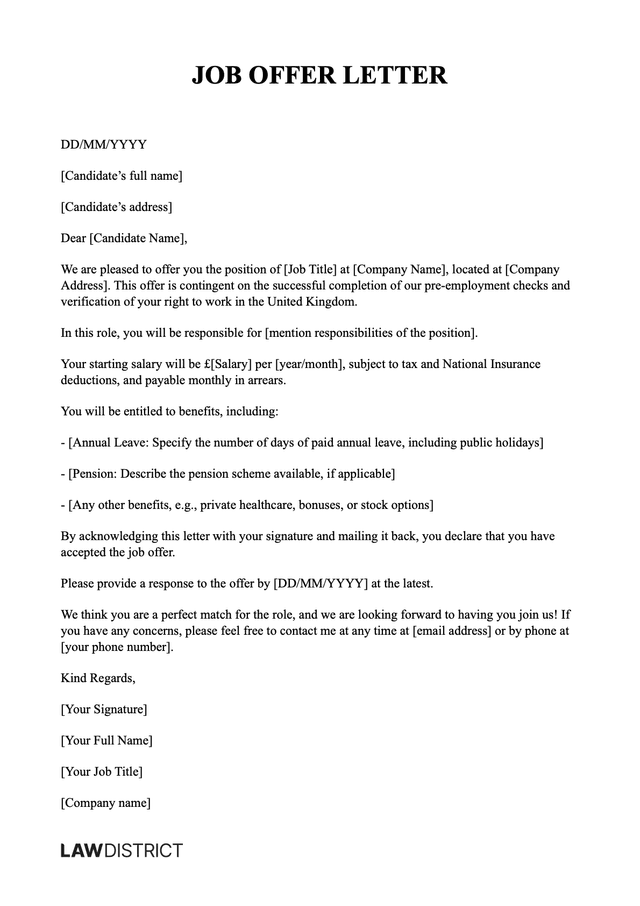
Before creating your own Job Offer Letter for the UK, it can be useful to review an example to understand its typical structure and content.
Our free Job Offer Letter example below provides a sample of how to format your draft and highlights the key details you should include.
What to include in a Job Offer Letter?
A Job Offer Letter summarises the terms of employment, ensures clarity and avoids misunderstandings between both parties.
Key elements to include are:
- Job title and description: Clearly state the position being offered, along with a brief summary of the role’s duties and responsibilities and reporting structure.
- Salary and benefits: Outline the salary package, including base pay, bonuses, pension contributions, and any additional benefits such as health insurance or company car.
- Start date and working hours: Specify the proposed start date, working hours, and whether the role is full-time, part-time, or involves flexible working arrangements.
- Place of work: Specify the place of work and set out if the work is on-site, remote or hybrid.
- Post-termination restrictions: Include terms for non-compete, non-solicitation of clients and non-poaching of employees
- Conditions of employment: Include any conditions that must be met before employment begins, such as satisfactory references, right to work checks, background checks, or completion of a probationary period.
- Holiday entitlement: Detail annual leave entitlement, sick leave, parental leave and any public holidays included.
- Contract type: Indicate whether the position is permanent, temporary, or fixed-term.
- Termination: Outline how the employment contract may be terminated during the probation period.
- Duties and conduct: Detail the company policies and code of conduct employees must follow.
- Acceptance details: Provide clear instructions on how to formally accept or decline the offer, including any deadlines for responding.
This ensures both employer and employee have a mutual understanding of the key terms before finalising the employment contract.
FAQs about Job Offer Letters
Gain a clearer understanding of Job Offer Letters with our frequently asked questions.
Yes, a Job Offer Letter can be legally binding in the UK once the offer is accepted. If the offer is unconditional, accepting it forms a legally binding employment contract.
Conditional offers differ because certain requirements must be met before the contract becomes binding; for example, satisfactory references or background checks.
Yes, salary can be negotiated after receiving a job offer. It is generally recommended to negotiate before accepting the offer, as this is when you have the most leverage. However, if you have not yet signed a contract or started the role, it may still be possible to reopen discussions.
Ensure you are respectful, provide clear reasons for your request, and be prepared for any outcome, including the possibility that the employer may decline.
Try Lawdistrict Now
Instant and complete access to our entire library of legal forms
Edit, download and print in PDF from any device
Save time and money on legal document creation