
Letter Before Action Template UK
A Letter Before Action is a formal pre-court letter. It sets out your claim, what you want, and a deadline to respond before court action starts.

What is the basis of the claim being advanced in this letter before action?
Fill forms in a few steps
Save, print & download
Done in 5 minutes
What is the purpose and function of a Letter Before Action?
A Letter Before Action is a formal written notice sent to an individual or business before issuing a civil court claim.
This legal document explains the dispute. It summarises the key facts, and sets out what you want the other party to do to resolve the issue.
In England and Wales, it sits within pre-action conduct under the Civil Procedure Rules. The purpose is to:
- Encourage early communication
- Exchange key information
- Explore settlement before proceedings begin
The court may later consider whether both parties acted reasonably at the pre-action stage.
You may also see the same document described as a letter before claim, pre-action letter, or pre-action protocol letter.
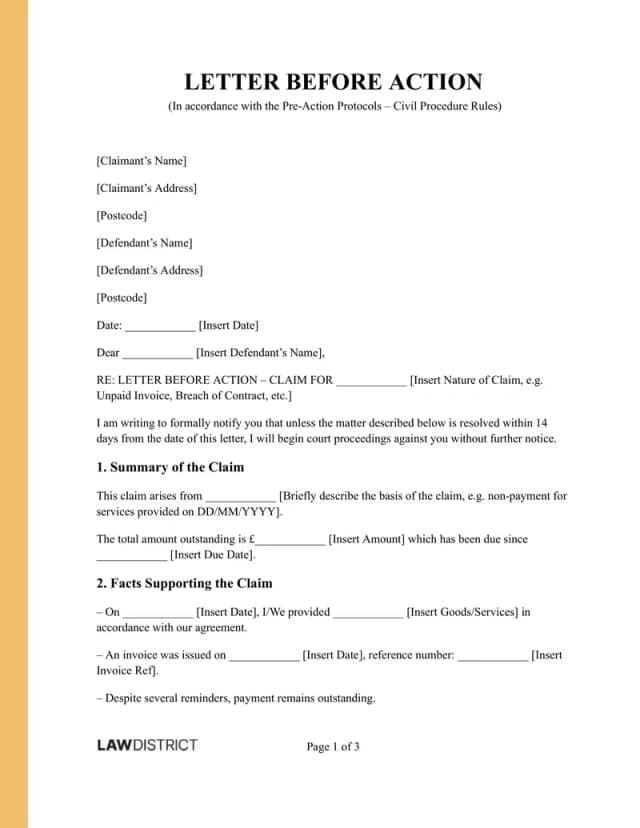
Example of Letter Before Action: PDF & Word
Reviewing a completed example of a Letter Before Action helps you understand the expected structure, tone, and level of detail. Here is a quick template to give you an idea of what you should include:
How to write a Letter Before Action
A well-written Letter Before Action should be factual and proportionate. It should normally include the following steps and information:
| Action | What to include |
|---|---|
| 1. Identify the parties | State your full name and address, and those of the recipient. |
| 2. Explain the background | Describe what happened, using key dates and a short timeline. |
| 3. State your claim | Explain the dispute and the legal basis of your claim. |
| 4. Specify what you want | Clearly state the remedy sought, such as payment or another action. |
| 5. Explain the amount | Show how any claimed amount has been calculated. |
| 6. List supporting documents | Refer to and attach key evidence, such as contracts or invoices. |
| 7. Set a response deadline | Give a clear and reasonable date for a response. |
| 8. Explain next steps | State that court proceedings may follow if unresolved. |
| 9. Invite resolution | Indicate willingness to settle or use another dispute resolution method. |
For some disputes, such as business-to-individual debt claims, a specific pre-action protocol applies and requires additional information and longer response times.
You can use our customisable Letter Before Claim template to quickly create a document adapted to your circumstances, ready to be sent. Simply fill in the details and download the finished Letter.
The process of sending and receiving a Letter Before Action
Sending a Letter Before Action starts the formal pre-action stage of a dispute. The steps below explain how the process works, from drafting the letter to the next stage if the issue is not resolved.
| Stage | What happens | Typical timeframe |
|---|---|---|
| 1. Prepare the letter | Gather evidence and draft the Letter Before Action setting out the claim and remedy | Before sending |
| 2. Send the letter | The letter is sent to the other party by email, post, or both | Day 0 |
| 3. Response period | The recipient responds, disputes the claim, or proposes settlement | Usually 14–30 days |
| 4. Review the response | You assess the reply and consider next steps | Shortly after response |
| 5. Resolution or escalation | The dispute is settled, or court proceedings are issued | After deadline passes |
Financial and legal implications of sending a Letter Before Action
Sending or receiving a Letter Before Action can have important consequences:
- Court fees may become payable if a claim is issued.
- Legal advice or drafting costs may be incurred.
- Poor pre-action conduct can affect costs decisions.
- Time limits for bringing a claim still apply.
A well-prepared letter can reduce risk by encouraging early resolution and clarifying the issues in dispute.
Letter Before Action FAQs
Below are answers to some of the most common questions about using a Letter Before Action in the UK.
Yes, a Letter Before Action can usually be sent by email. This is acceptable where email is a reasonable method of communication. This also allows you to keep a clear record of sending and delivery. In some cases, sending a copy by post may also be sensible.
No, it is not always a strict legal requirement. However, courts expect parties to follow pre-action conduct. They may take a failure to send a Letter Before Action into account when dealing with costs or case management.
You can create a comprehensive Letter Before Action in just a few seconds with the help of our template. It’s recommended to have a legal professional review the document before you send it. They can make sure it aligns with standard legal drafting.
Try Lawdistrict Now
Instant and complete access to our entire library of legal forms
Edit, download and print in PDF from any device
Save time and money on legal document creation