
Party Wall Notice Template
A Party Wall Notice is a legal document used to formally notify a neighbour about certain planned building works in England and Wales. It allows you to explain the proposed work and when it is expected to start. It differs from a Party Wall Agreement, which is used to agree on the terms.

Fill forms in a few steps
Save, print & download
Done in 5 minutes
What Is a Party Wall Notice?
A Party Wall Notice is a legal document made under the Party Wall etc. Act 1996.
A party wall is a wall or structure shared with a neighbouring property. If your work affects one, you may need to serve your neighbour a Party Wall Notice first.
The notice usually includes key information such as:
- The building owner’s name and address
- Details of the proposed work
- The property affected
- The proposed start date
The type of notice required depends on the work being carried out. This may include work to a party structure, building near a boundary, or excavating near a neighbouring property.
Some people refer to this document as a Party Wall Agreement, but this is a different document.
When do you need a Party Wall Notice?
Before you start work, check if your project falls into one of these situations:
- Cutting into a party wall, such as adding steel beams.
- Raising, thickening or demolishing a party wall.
- Building a new wall on or across the boundary line.
- Excavating within 3 or 6 metres of a neighbour’s foundations.
- Underpinning or strengthening a party wall or foundation.
- Removing a chimney breast attached to a party wall.
- Adding loft beams that bear on the party wall.
- Structural works in flats affecting party walls or party structures.
You may need to use a Party Wall notice if your construction work falls into the above categories.
Party Wall Notice example (PDF & Word)
Before you draft your own Party Wall Notice, it can help to look at a sample document, such as the template below. You can use it to guide you when creating your own document:
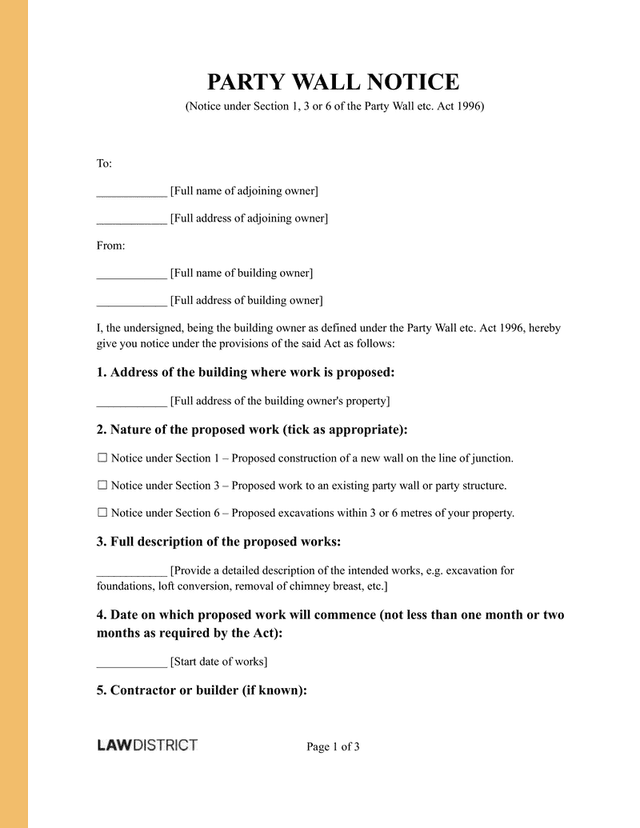
How to get a Party Wall Notice
You can write your own Party Wall Notice, or use our template to make it instantly, customized to your project. The points below describe the main areas usually covered in this type of document.
1. Add the owner details
Enter the building owner’s name and address. You should also include the adjoining owner’s details, if known, and the address of the neighbouring property.
2. Describe the proposed work
Explain what work you plan to carry out. You need to specify which wall, structure, boundary, or excavation it affects. Ensure that you add enough detail for the adjoining owner to understand the proposal.
3. Identify the correct type of notice
The notice depends on the work involved. It may be a Party Structure Notice, Line of Junction Notice, or Notice of Adjacent Excavation. Our template uses the details you provide to generate the correct type of notice for your project.
4. Add the proposed start date
Next, you should when you expect the work to begin. Party Structure Notices generally require two months’ notice.
Boundary and excavation notices generally require one month.
5. Include any required plans or details
Some works may need extra information, such as plans or details about excavations or special foundations. Make sure that you know your exact plans and include them accurately in the Notice before you send it.
6. Serve the Party Wall Notice
Send the completed notice to the adjoining owner before the relevant notice period begins. Make sure to keep a copy of the notice and any response you receive for your records. This can come in handy later if a dispute arises.
7. Wait for the adjoining owner’s response
The adjoining owner may consent, disagree, or take other action allowed under the Act. Do not assume that no response means consent. This can lead to a lengthy dispute process between the parties.
Extra considerations after getting a Party Wall Notice
The following table outlines some extra considerations to consider after you serve your Notice.
| Consideration | Explanation |
|---|---|
| Keeping copies | Keep signed copies in a safe place. You may need them if a dispute arises later. |
| Time limits for starting works | Check any time limits in the agreement or the Act for starting and completing the works. |
| Changes to the planned works | Seek advice if you change the design. Significant changes may **need a new agreement**. |
Party Wall Notice vs Party Wall Agreement
A Party Wall Notice and Party Wall Agreement serve completely different purposes. The table below outlines the main differences:
| Party Wall Notice | Party Wall Agreement | |
|---|---|---|
| Purpose | Used to notify your neighbour about planned building works. | Records terms agreed between you and your neighbour. |
| When it is used | Before certain work starts under the Party Wall etc. Act 1996. | May be used after notice has been served if both owners want to record agreed terms. |
| Who creates it | The building owner serves it on the adjoining owner. | The owners can agree the terms between themselves. They often use a Party Wall Agreement template. |
| What it covers | Details of the proposed work and when it is expected to start. | Agreed points such as access, working arrangements, costs, or repairs. |
| Is it always required? | It may be required for certain work covered by the Act. | No. A Party Wall Notice does not always lead to a separate agreement. |
Party Wall Notice FAQs
Below are the answers to the most common questions about the use of Party Wall Notices and Agreements in England and Wales.
No, you should always serve a Party Wall Notice and secure a Party Wall Agreement before works start. Once works are complete, it is usually too late to follow the proper procedure under the Act. Without an agreement in place, any disputes are then more likely to be resolved through general civil claims.
You do not always need a Party Wall surveyor, but it is often advisable. If your neighbour dissents or does not respond to a notice, surveyors must normally be appointed under the Act. A surveyor can also help draft a clear agreement and manage any disputes.
Your neighbour can respond in different ways. They may:
- Consent to the work
- Agree extra terms with you
- Disagree
If a dispute arises, the next step may involve appointing a surveyor.
A Party Wall Award is the formal Party Wall Agreement made by an appointed surveyor or surveyors. It records the works, access rights, protections, and how damage will be dealt with. The Award is legally binding on both owners and can be enforced or challenged only in limited cases.
There is no fixed fee for a Party Wall Agreement. Costs depend on surveyor rates, complexity of the works, and whether one or more surveyors are appointed. In many cases the building owner pays the surveyors’ fees, as well as the cost of the works and any making good.
Try Lawdistrict Now
Instant and complete access to our entire library of legal forms
Edit, download and print in PDF from any device
Save time and money on legal document creation