
Rent Increase Notice (Section 13) for UK Landlords
A Rent Increase Notice is the document a landlord uses to tell a tenant that the rent will go up. The exact rules depend on where your property is and what type of tenancy or occupation contract you have. This document creates a record of this notice, which can help you if disputes arise in the future.

Fill forms in a few steps
Save, print & download
Done in 5 minutes
What is a Rent Increase Notice (Section 13)?
A Rent Increase Notice is a written document that informs your tenant of:
- The new amount of rent to be paid
- The date the new rate will come into effect
This legal document is important because it gives the tenant the information in writing. This helps avoid confusion about when the new rent applies.
It also creates a clear record of the change, which can be useful for both the landlord and the tenant later on.
In England, Section 13 is the legal process used to propose a new rent for an assured periodic tenancy.
How to increase rent as a landlord
To increase rent correctly, you need to follow the right legal steps from the start.
Here are the steps to follow if you want to increase rent:
- Check whether the tenancy is fixed term or periodic
- Read the tenancy agreement for any rent review clause
- Use the correct official form for your jurisdiction
- Give the full legal notice period
- Make sure the new rent is fair and close to market level
- Keep proof that the notice was served
How to draft a Section 13 Rent Increase Notice
Before you send a rent increase notice, make sure the document is to-the-point and easy for your tenant to understand.
A well-drafted notice reduces confusion and shows the rent change in a professional way.
Here are the steps to successfully draft this document yourself:
| Step | What to include |
|---|---|
| 1. Confirm the tenancy details | Check the tenant’s name, property address, and the type of tenancy before you begin |
| 2. Add the current rent | State the rent the tenant is paying now so there is no doubt about the change |
| 3. Add the new rent | Clearly write the new rental amount you want to charge |
| 4. Include the start date | Show the exact date the new rent will begin |
| 5. Keep the wording clear | Use simple language so the tenant can understand the notice quickly |
| 6. Mention the reason if needed | You can briefly explain the increase, such as market changes or rising property costs |
| 7. Review the notice carefully | Check names, dates, and amounts to avoid mistakes |
| 8. Keep a copy for your records | Save a copy of the final notice for reference after it is sent |
If you need to quickly make this document you can use our customizable Rent to Increase Notice template. Simply enter the details of the tenancy and you’ll instantly received the finished document, ready to be sent.
Important: Starting from 1 May 2026, you must give your tenant at least two months’ notice of any increase to their rent. This change is part of the Renters’ Rights Act.
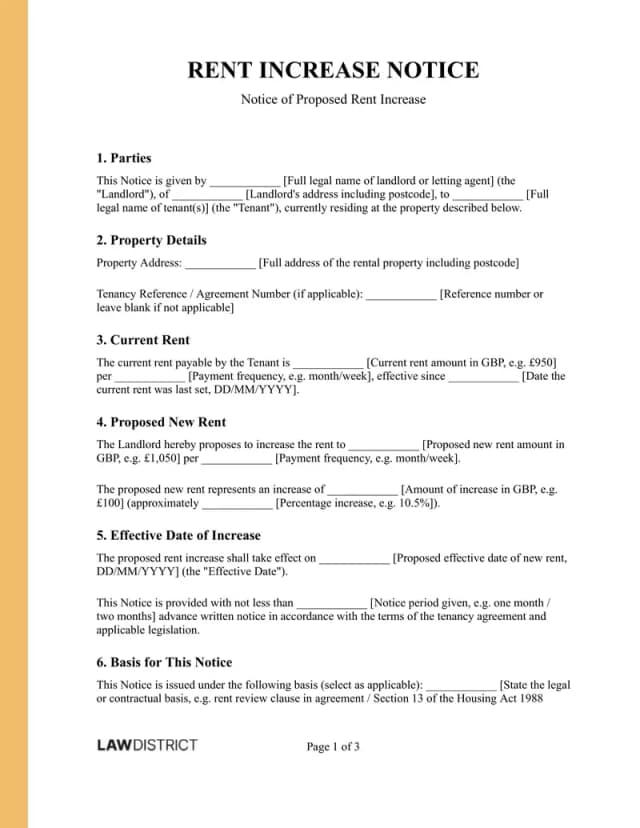
Sample Notice of Increase in Rent
Before you begin drafting your Notice, it’s important to understand how the document should look. Have a look at our finished Rent Increase Notice example below:
UK Rent Increase laws and rules
The rules below give you a quick view of the most common situations. Always check the exact tenancy type before serving notice.
| Situation | Rule |
|---|---|
| England periodic assured tenancy (before 1 May 2026) | Rent can usually be increased by agreement or by using Section 13 Form 4 under the current rules |
| England fixed-term tenancy (before 1 May 2026) | You usually need a valid rent review clause or must wait until the fixed term ends |
| England from 1 May 2026 | Most private tenancies in England become periodic by default. Landlords must follow the revised Section 13 process, use the prescribed Form 4A, give at least 2 months’ notice, and can usually increase rent only once a year up to the open-market level. |
| Wales | Landlords should use Form RHW12 to tell contract-holders about a change in rent |
| Scotland | Landlords must give at least 3 months’ written notice and use the correct prescribed notice |
| Fairness of increase | In England, the increase must be fair and realistic and in line with open-market rents |
| If the tenant disagrees | In England, the tenant can ask the tribunal to decide the correct rent. Scotland also has a formal challenge route |
FAQs about Rent Increase Notices
Still have some doubts? Here are some FAQs related to this document.
There is no single percentage cap that applies in every UK case. The key rule is that the increase must follow the correct legal process and should be fair.
In England, the new rent should be realistic and in line with reasonable open-market rents.
It depends on the location and tenancy type. In England, the current Section 13 rules apply to periodic assured tenancies under Form 4A. Tenants usually must receive at least two months’ notice.
In Wales, landlords use RHW12 and must give tenants at least 2 months’ notice.
In Scotland, landlords must give at least 3 months’ written notice.
A tenant can challenge the increase instead of simply accepting it. In England, the tenant can apply to the First-tier Tribunal if they think the proposed rent is unfair.
In Scotland, tenants can also use the formal review process. If your notice is invalid, the increase may not take effect.
Try Lawdistrict Now
Instant and complete access to our entire library of legal forms
Edit, download and print in PDF from any device
Save time and money on legal document creation