Tenancy Agreement template for UK rentals

A tenancy agreement is a written legal document that sets out the terms of a rental arrangement between a landlord and a tenant. It usually includes key details such as the rent, deposit, notice periods, and the rights and responsibilities of each party.

Trusted by 5,670 users.

update icon

Last Update 13 April 2026

check icon

Reviewed by Ali Talip Pınarbaşı, Solicitor

Also Known As:

Assured shorthold tenancy agreement (AST)

Letting agreement

Rental agreement

Landlord tenancy agreement

Short-term tenancy agreement

Occupation contract (Wales)

Fixed-term standard contract

Periodic-term standard contract

Fill forms in a few steps

Fill forms in a few steps

Save, print & download

Save, print & download

Done in 5 minutes

Done in 5 minutes

What is a Tenancy Agreement?

A Tenancy Agreement is a legally binding contract between a landlord and tenant, outlining the terms under which the tenant can occupy the property.

This type of agreement details the rights and responsibilities of both parties, covering aspects such as:

  • Rent and rent increases
  • Deposit
  • Duration of tenancy
  • Responsibility for repairs, maintenance, and insurance
  • Right to sublet

Tenancy agreements can be written or oral, though written agreements provide more security and clarity for both you and your future tenants.

Create a UK Tenancy Agreement that follows housing laws in your area with our easy-to-follow template.

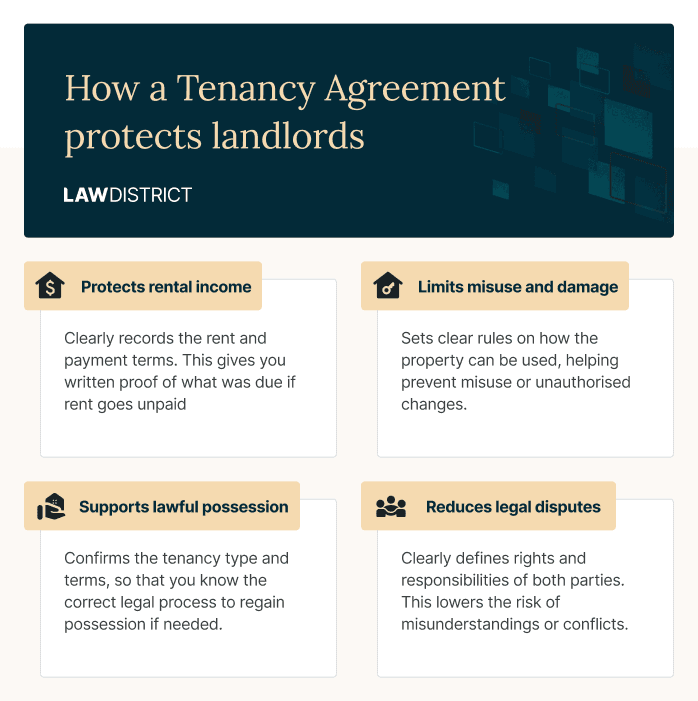
tenancy-agreement-benefits-landlords

Tenancy Agreement updates under the Renters’ Rights Act 2026

The Renters’ Rights Act 2025 introduces significant changes to how tenancy agreements work in England. It replaces the previous Section 21 system with new rules that strengthen tenant protections and change how tenancies are:

  • Structured
  • Managed
  • Ended

From 1 May 2026, new tenants in England should receive a written statement of terms before agreeing to the tenancy. This must include key details such as the rent and the landlord’s name and address.

What replaces Assured Shorthold Tenancy Agreements?

Before 1 May 2026, most private renters in England had an assured shorthold tenancy (AST).

From 1 May 2026, most of these tenancies move to the new assured tenancy system. Under the Renters’ Rights Act 2025:

  • Fixed-term ASTs are no longer the standard
  • Most tenancies are now periodic (rolling) agreements by default
  • Section 21 “no-fault” evictions have been abolished

This means:

  • Tenancies no longer end automatically after a fixed term
  • Tenants can stay indefinitely unless valid legal grounds apply
  • Landlords must follow stricter legal procedures to regain possession

You may still see ASTs referenced, but they now apply mainly to legacy agreements signed before the law change.

Difference between a lease and Residential Tenancy Agreement in the UK

The terms “Lease” and “Tenancy Agreement” are sometimes used interchangeably, however, they usually refer to different types of letting arrangements.

While the term “Tenancy Agreement” typically refers to residential letting, “lease” is usually used in reference to long-term arrangements and for the lease of commercial property.

The table below explains the key distinction between a Lease and a Tenancy Agreement form.

Tenancy Agreement Lease
Duration Typically periodic (rolling) Usually long-term (over 3 years).
Termination Tenant can leave with notice; landlord needs legal grounds. Fixed term. Early termination can be complex and is often subject to strict conditions.
Use Used for residential properties. Used for both residential and commercial properties.
Legal formality Usually a written agreement, could also be entered into verbally if it is for less than 3 years. If a lease is more than three years, it must be signed as a deed, and this deed must satisfy specific requirements.
Flexibility More flexible. Terms can be changed with the mutual agreement of the parties without formalities. Less flexible. Formalities to change the lease via deed of variation must be followed.
Registration Not required to be registered. Leases extending a certain term (usually over 7 years) must be registered at the Land Registry.

Tenancy Agreement Sample

Creating a Tenancy Agreement in the United Kingdom can feel overwhelming without a clear starting point. Our sample Tenancy Agreement offers a structured template, guiding you through essential components.

Use this example of a simple Tenancy Agreement for the UK to craft a comprehensive form tailored to your specific needs.

view preview icon
uk-tenancy-agreement-uk-sample

When you should use a Tenancy Agreement

In the UK, a Tenancy Agreement is crucial in various scenarios. Here are some examples of when you may need one:

  • Renting out property: Essential for property owners wanting to rent out their property.
  • Renting a place to live: Crucial for individuals or families looking for a rental home.
  • Subletting: Necessary when a tenant wishes to rent out part or all of their leased property to another individual.
  • Short-term rentals: Important for short-term stays beyond typical holiday durations.

Using this document correctly is even more important from 2026, as Tenancy Agreements must reflect the new periodic tenancy system and updated legal rules on ending a tenancy.

Types of properties that need Tenancy Agreements

Tenancy Agreement forms apply to a variety of property types in the United Kingdom. For residential purposes, you can create a contract if you plan to rent out a:

  • Flats
  • Houses
  • Shared accommodations (e.g., single rooms)

However, you can also use a commercial lease if you plan to rent out one of the following to a business:

  • Office
  • Retail space
  • Warehouse
  • Industrial unit

Make sure you understand what agreement you should use and what to include in your document to correctly make a Tenancy Agreement.

Do I need to pay fees on a Tenancy Agreement

Following the Tenant Fees Act, most letting fees paid by tenants in the private rented sector have been banned.

Only permitted payments as defined under the Tenant Fees Act 2019 may be charged. Some of the permitted charges are as follows:

  • Late rent fees
  • Lost keys or fobs
  • Ending tenancy early
  • Changing or transferring the tenancy

Terms to include in a Tenancy Agreement

When crafting a tenancy agreement, make sure to address key terms:

  • Property address
  • Names of all parties involved
  • Rental amount and payment details
  • Start date of the tenancy
  • Tenant and landlord obligations
  • Procedure for reporting and dealing with repairs and maintenance
  • Insurance implications
  • Deposit details and protection scheme information
  • Conditions under which the deposit may be withheld
  • Circumstances where Landlords may make deductions from the deposit
  • Responsibility for bills, such as gas, water, internet, and electricity bills
  • Responsibility for council tax
  • Notice periods to end the tenancy agreement and formalities

How to write a Tenancy Agreement

Follow these steps to understand how to draw up a Tenancy Agreement.

Take advantage of our free Tenancy Agreement form for the UK, along with the following instructions to avoid issues during your tenancy.

  1. State the property type: Tick if the property is furnished or unfurnished.
  2. Identify the parties: Clearly state the full names, addresses, and contact information of the landlord(s) and tenant(s).
  3. Describe the property: Detail the address and type of property being rented, including specific rooms or amenities that are included or excluded.
  4. Outline the main terms: Specify the number of occupants, rent details, and any included services.
  5. Provide deposit information: State if there is a deposit and define the amount.
  6. Include confidentiality and data protection clauses: Include conditions that comply with GDPR (General Data Protection Regulation), detailing how the personal information of the tenants will be handled and protected.
  7. Attach documents: State if any other documents are attached to the agreement.
  8. Signatures: Ensure the agreement is signed by all parties involved. While not always required, having witnesses to the signing can add validity.

Why use Lawdistrict for your Tenancy Agreement

Use our free UK Tenancy Agreement template to create a bespoke written agreement that provides clarity and eliminates risks of disputes between landlord and tenant.

Our template can help you and your tenants stay protected and clear about your respective rights and obligations, and comply with applicable tenancy-related laws in the UK.

You can download our basic UK Tenancy Agreement PDF or Word document. However, for a more detailed contract, personalise your own with our online tool to add the important details that are specific to your agreement.

Once you have your contract, you can have it reviewed quickly by a legal professional to guarantee it’s ready to be put into effect.

Tenancy Agreement FAQs

Navigating the complexities of Tenancy Agreements can be challenging. Here, we address some frequently asked questions to help clarify important aspects of Tenancy Agreements in the UK.

How long does a guarantor stay on a Tenancy Agreement?

A guarantor's obligations under a tenancy agreement typically last for the duration of the tenancy.

If the tenancy is extended or transitions into a periodic tenancy (rolling from month to month), the guarantor's responsibilities usually continue. However, the wording of the guarantee may provide otherwise.

Guarantors need to understand that they may be liable for unpaid rent or costs for damage beyond normal wear and tear for as long as the Tenancy Agreement is in effect.

What happens when a tenancy continues in 2026?

From 1 May 2026, most private tenancies in England are periodic by default. This means that they do not automatically end after a fixed term.

A tenant can usually end the tenancy by giving 2 months’ notice, unless a shorter notice period was agreed in writing. In contrast, a landlord can only seek possession if they have a valid legal ground and follow the correct legal process.

What are my rights if I do not have a Tenancy Agreement in the UK?

Even without a written tenancy agreement, tenants in the UK are automatically protected under the law. You have the right to:

  • Live in the property undisturbed
  • Challenge excessively high charges
  • Live in a safe property in a good state of repair
  • Be protected against unfair rent and unfair eviction
  • Have your deposit returned at the end of the tenancy (provided you meet the terms of your tenancy)

A verbal agreement can still be legally binding, but proving the terms of the agreement can be more challenging.

It's always best to have a written agreement to avoid misunderstandings and ensure that both parties are clear on their rights and responsibilities.

Can I write my own tenancy agreement in the UK?

Yes, you can draft your own rental agreement in the United Kingdom, as long as it includes all legally required terms and clearly sets out the rights and responsibilities of both landlord and tenant.

Using our Landlord Agreement template, you can cover the key clauses and avoid common omissions. Once it’s complete, you can have a solicitor review the agreement to confirm that everything is correct and legally compliant.

view preview icon
uk-tenancy-agreement-uk-sample

You are only a few steps away from your own Tenancy Agreement!


Download our professional examples

Preview of your Tenancy Agreement

ASSURED SHORTHOLD TENANCY AGREEMENT
THIS TENANCY AGREEMENT SHALL START ON THE ________ day of ________________, ________.
BY AND BETWEEN: THE PARTIES

_________

(individually and collectively the "Landlord")
AND

_________

(individually and collectively the "Tenant")

(individually the "Party" and collectively the "Parties")
The Landlord shall lease the premises to the Tenant in accordance with the provisions that follow:
TYPE OF PROPERTY:
A. This is an agreement for an Assured Shorthold Tenancy as defined under Section 19A of the Housing Act 1988 as amended or as supplemented by any other applicable and relevant laws.
B. As the owner of the residential property let under this Tenancy Agreement, the Landlord is entitled to grant this tenancy.
LET PROPERTY
1. The Parties agree to the following:

The Landlord shall let the property to the Tenant and the Tenant shall take the tenancy of the house.

The property is located at _________ (the "Property") and shall be used as residential premises only.
2. Pets are not allowed on the Property without the prior written permission of the Landlord. The Landlord may revoke it at any time as long as a (30) days notice is given to the Tenant.
3. The Landlord does not permit smoking on the Property. This prohibition applies to the Tenant and any of the Tenant's guests or visitors.
TERM
4. This Tenancy Agreement shall commence on _________ and shall end on _________ (the "Term").
5. A new month-to-month tenancy shall be created between the Landlord and the Tenant, subject to all the original terms and conditions of this Agreement, if the Parties do not end this tenancy before the expiry term. This month-to-month tenancy shall terminate with the Landlord's notice to the Tenant, as required under the applicable legislation of England (the "Act").
RENT
6. In accordance with this provision, the rent for the Property is £_________ per month (the "Rent").
7. The Tenant shall pay the rent in advance, on the _________ of each month. This rent amount shall be paid to the Landlord for the complete Term of this Tenancy Agreement at _________ by:
8. The Tenant may be charged by the Landlord a late payment fee as an additional amount for each day that the Rent is late. This fee shall not be charged until the grace period expires and shall not exceed the maximum permitted under the Act.
9. The Landlord and its agents may enter the Property at reasonable times to carry out inspections or make repairs. The Landlord and its agents shall also have the right to show the Property to prospective tenants or purchasers.
TENANT IMPROVEMENTS
10. The Landlord shall give the Tenant written permission before the Tenant can do any of the following:

     a. apply any material, or insert nails or hooks in the walls or ceilings, except for small picture hooks.
     b. paint or redecorate, or in any way significantly alter the appearance of the Property.
     c. perform structural alterations.
     d. use waterbed(s).
     e. change the amount of power used on the Property.
     f. install additional electrical wiring.
     g. place or expose any placard, notice, or sign for any purpose.
     h. affix any radio or TV antenna to or near the Property.
UTILITIES AND OTHER CHARGES
11. The Tenant shall be responsible for paying all utilities.
INSURANCE
12. The Tenant is hereby advised that the Landlord shall not insure any of the Tenant's property for damage or loss.
ABSENCES
13. The Landlord will be informed by the Tenant of any prolonged absence from the Property. The Landlord considers a prolonged absence to be any absence from the Property of (28) days or more. Further, the Tenant shall take all measures necessary to secure the Property before an absence from the Property occurs, and shall also be responsible for taking the appropriate measures to prevent frost or flood damage.
14. The Landlord may end the tenancy by serving on the Tenant a Notice to Quit if the Tenant ceases to occupy the Property as a principal home. The Landlord shall have such right even if the Tenant intends to return to the Property and live in it as its principal home.
15. The Landlord shall have the right to apply for a court order for possession of the Property if the Tenant abandons the Property and the Landlord has no certainty if the Tenant plans to return.
16. If the Landlord deems that the Tenant has abandoned the Property and that, as a result of such action, the Property is under any risk of suffering damage, then the Landlord may enter the Property to secure the Property or carry out any emergency repairs. If the Tenant has changed the locks of the Property, the Landlord shall require such Tenant to provide the Landlord with a new key or access to the Property.
17. If there an is implied or actual surrender of the Property by the Tenant, the Landlord may, at its option, enter the Property by any means without being liable for any prosecution for such entering, and without becoming liable to the Tenant for damages or for any payment of any kind whatever, and may, at the Landlord's discretion, as agent for the Tenant, let the Property, or any part of the Property, for the whole or any part of the then unexpired term, and may receive and collect all rent payable under such letting, and, at the Landlord's option, hold the Tenant liable for any difference between the Rent that would have been payable under this Agreement during the balance of the unexpired term, if this Agreement had continued in force, and the net rent for such period realized by the Landlord by means of the letting. Implied surrender will be deemed if the Tenant has left the keys behind or where the Tenant has ceased to occupy the Property and clearly does not intend to return.
18. If the Tenant has abandoned or surrendered the Property and the Tenant has left some belongings on the Property, the Landlord will store the Tenant's possessions with reasonable care for a reasonable period of time, taking into consideration the value of the items and the cost to store them. Once the cost of storage is greater than the value of the items, such items may be disposed of by the Landlord.
GOVERNING LAW
19. This Agreement shall be governed, construed, and interpreted in accordance with the laws of England and the Parties submit to the exclusive jurisdiction of the English Courts.
SEVERABILITY
20. If any provision of this Agreement is in conflict with the the Act, the Act shall prevail. In any such circumstance, those provisions of the Agreement in conflict with the Act shall be amended or eliminated as necessary to comply with the Act. Further, any and all provisions required by the Act shall be part of this Agreement. Lastly, the remaining provisions shall not be affected by such provision and will continue to be valid and enforceable.
AMENDMENT OF AGREEMENT
21. This Agreement may only be modified or amended in writing if it is executed by the Parties.
ASSIGNMENT AND SUBLETTING
22. The Tenant shall not assign this Agreement, sublet the Property, or grant any concession or licence to use the Property or any part thereof. If the Tenant takes any such action, the Landlord shall render those actions void and automatically terminate this Agreement.
DAMAGE TO PROPERTY
23. The Landlord may end this Agreement by giving the Tenant appropriate notice if the Property suffers any damage and the Landlord decides not to rebuild or repair the Property.
CARE AND USE OF PROPERTY
24. The Landlord shall be promptly notified by the Tenant of any damage that may affect the normal use of the Property.
25. The Tenant shall keep the Property in good repair and condition.
26. The Tenant shall not engage in any illegal activity on the Property.
27. The Parties shall comply with health, sanitation, fire, housing, and safety standards in accordance with the law.
28. The Landlord will be informed by the Tenant of any prolonged absence from the Property. The Landlord considers a prolonged absence to be any absence from the Property of (28) consecutive days or more. Further, the Tenant shall arrange for an inspection to be done by a competent person while the Tenant is absent. Lastly, the Tenant shall take all measures necessary to secure the Property before an absence from the Property occurs and shall also be responsible for taking the appropriate measures to prevent frost or flood damage.
29. The Tenant shall quit and surrender the Property in as good state and condition as when the Tenant took possession of the Property at the commencement of this Agreement, reasonable wear and tear excepted.
RULES AND REGULATIONS

30. The Tenant agrees to obey all rules and regulations implemented by the Landlord which are reasonable, regarding the use and care of the Property and the building, including any car park and common parts or shared facilities provided for the use of the Tenant.
TERMINATION OF TENANCY

31. The Tenancy may be terminated by the Landlord under any ground provided by the Act after serving notice on the Tenant. Further, the Landlord may serve such notice to terminate the tenancy at the expiry of the tenancy (a Section 21 notice to quit), if the Tenant has not complied with any of the obligations set under this Agreement (e.g. a Section 8 notice seeking possession), or for any other ground provided in the Act (such as the Landlord seeking to live on the property again).
ADDRESS FOR NOTICE
32. For any matter relating to this tenancy, the Tenant may be contacted at the Property or through the phone number below:

     a. Name: _________.

     b. Phone: _________.

     c. Email address: _________.
33. For any matter relating to this tenancy, whether during or after this tenancy has been terminated, the Landlord's address for notice is:

     a. Name: _________.

     b. Address: _________.
The contact information for the Landlord is:

     a. Phone: _________.

     b. Email address: _________.
34. The Parties may change their respective addresses for notice under this Agreement by providing written notice of such fact.
GENERAL PROVISIONS
35. The Landlord may waive the Tenant's failure to comply with the provisions of this Agreement. However, any such waiver of the Tenant's non-compliance shall not apply to subsequent defaults.
36. This Agreement will extend to and be binding upon and inure to the benefit of the respective heirs, executors, administrators, successors, and assignees, as the case may be, of each Party to this Agreement. All covenants are to be construed as conditions of this Agreement.
37. Where there is more than one Tenant executing this Agreement, all Tenants are jointly and severally liable for each other's acts, omissions, and liabilities pursuant to this Agreement.
38. Locks may not be added or changed without the prior written agreement of both Parties, or unless the changes are made in compliance with the Act.
39. This Agreement may be executed in two or more counterparts, each of which shall be deemed to be an original.
40. This Agreement will constitute the entire agreement between the Parties.
41. The Tenant agrees to give access to the Landlord or its agents to the Property for the purpose of displaying signs to sell or let the Property. Such access may be granted at reasonable times.
IN WITNESS WHEREOF this Agreement was executed by the Landlord and the Tenant on this ________ day of ________________, 20____.


_______________________________
Witness
_______________________________
Address

Date: ______________


_______________________________
_________


_______________________________
Witness
_______________________________
Address

Date: ______________


_______________________________
_________


The Tenants acknowledge receiving a duplicate copy of this Agreement signed by the Tenants and the Landlord on the _____ day of ____________, 20____.


_______________________________
_________

Try Lawdistrict Now

Instant and complete access to our entire library of legal forms

Edit, download and print in PDF from any device

Save time and money on legal document creation