
Termination of Employment Letter UK template
A Termination of Employment Letter is a formal document used by UK employers to confirm the end of a worker's contract. It provides a written record of the reasons for dismissal. It also details like the last day they worked and the employee's right to appeal.

Fill forms in a few steps
Save, print & download
Done in 5 minutes
What is a Termination of Employment Letter?
A Termination of Employment Letter serves as the final, official step in a fair dismissal process.
This legal document outlines the reasons an employee is being let go. It helps make sure that there is no ambiguity regarding their final day or financial entitlements.
Beyond its administrative function, a dismissal letter is an important legal safeguard for your business.
With this letter, you can document the reasons for dismissal clearly in writing. This helps protect your business against "wrongful dismissal" or "unfair dismissal" claims in an Employment Tribunal.
Different types of employment termination
The reason for ending a contract dictates how the letter is written. It also indicates whether you’re required to pay notice pay to the dismissed employee.
Here are the most common types of dismissal under UK law:
| Type | Explanation |
|---|---|
| Summary Dismissal | This is an immediate termination without notice or pay, reserved for cases of "Gross Misconduct" like theft or violence. |
| Dismissal for SOSR | This covers "Some Other Substantial Reason" that does not fit into conduct or redundancy, such as a client refusal to work with a specific person. |
| Constructive Dismissal | This occurs when an employee resigns because the employer has committed a fundamental breach of the employment contract. |
| Redundancy | This happens when a specific role is no longer required by the business, requiring a fair selection process and statutory pay. |
| Capability Dismissal | This is used when an employee is unable to perform their job to the required standard due to a lack of skills or long-term ill-health. |
Termination of Employment Letter UK example
Take a look at the sample Termination of Employment Letter below to get a better idea of the structure and content of this document:
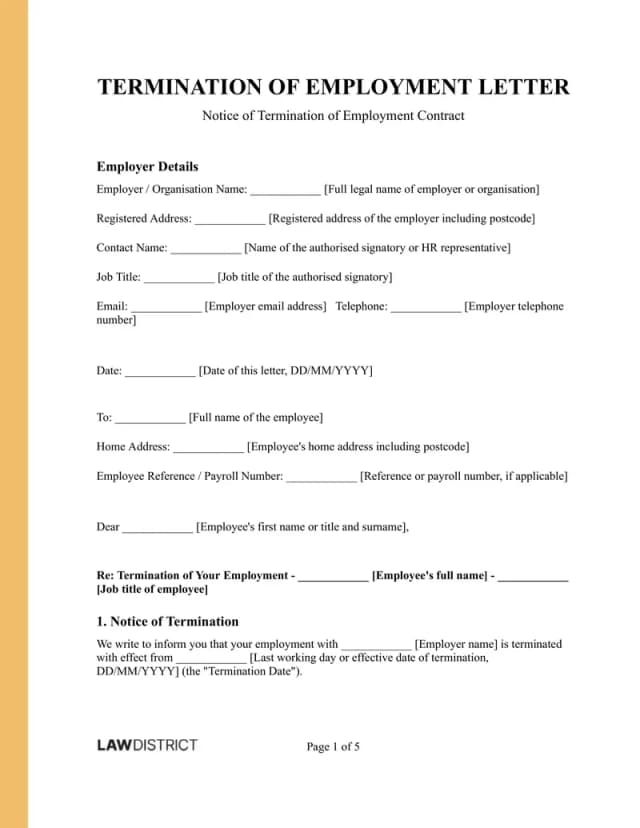
How to write Termination Letters
Writing a Termination Letter requires a specific structure and unambiguous language. Follow these steps to easily draft your own version of the document.
1. State the reason for dismissal clearly
Clearly identify the fair reason for the dismissal, such as:
- Conduct
- Redundancy
- Capability
Never write this letter using vague language. Every employee has a legal right to know exactly why their contract is being terminated.
2. Specify the final date and notice
State the employee’s final day of work and how their notice period will be handled. Confirm if they will:
- Work their notice
- Be placed on garden leave
- Receive a payment in lieu of notice (PILON)
3. Detail final payments and property
Next, you should list all outstanding financial matters. This may include accrued holiday pay and the date of the final payslip.
You should also include instructions for the return of company property, such as:
- Laptops
- Keys
- Security badges
4. Explain the right to appeal
Under the Acas Code of Practice, you must inform the employee that they have the right to appeal the decision. Provide a specific contact name and a deadline for them to submit their appeal in writing.
If you wan tto quickly draft your own version of this document, consider using our Termination of Employment Letter UK template. This is fully customisable, so you just need to enter your details and instantly receive the finished document.
Termination Letters FAQs
Here are some frequently asked questions regarding the legal termination of staff in the UK.
There are five fair reasons for dismissal:
- Conduct
- Capability
- Redundancy
- Statutory illegality
- "Some other substantial reason"
To avoid unfair dismissal claims, you must prove that one of these reasons applies. You have to show that you acted reasonably in the circumstances when making the decision to dismiss.
Employers should follow the Acas Code of Practice by investigating the issues and holding a formal hearing.
The employee must be allowed to be accompanied by a colleague or union representative.
After the meeting, the employer must provide a written decision and offer the employee the right to appeal.
A "short service" dismissal applies to employees with less than two years of continuous service.
In most cases, these employees cannot claim ordinary unfair dismissal.
However, employers must still provide the correct notice period and guarantee that the dismissal is not for a "discriminatory" or "automatically unfair" reason.
Try Lawdistrict Now
Instant and complete access to our entire library of legal forms
Edit, download and print in PDF from any device
Save time and money on legal document creation